Luxury Safari Holidays from the UK 2026: Africa, India and the Ultimate Wildlife Guide
At 5:47am, it is still dark. Your open-sided Land Rover is moving quietly through the South African bushveld, the tracker sitting on his seat at the front of the vehicle, studying the red clay road for signs that were left in the night. Then the tracker raises his hand and the vehicle stops. He speaks quietly to your guide in Shangaan. The guide translates: lion. Three males, passed here within the past hour. You drive off the road.
Fifteen minutes later, in the gathering dawn light, you find them. Three male lions resting in a clearing, their manes backlit by the first gold of the sunrise, watching the vehicle with a calm that comes from 50 million years of evolution at the top of the food chain. For the next 40 minutes, nobody speaks above a whisper. This is what a luxury safari in Africa delivers — an encounter with the natural world at a scale and intimacy that no screen, no zoo, no wildlife documentary can replicate.
For UK travellers, the combination of Africa safari with a traditional beach holiday or city break has been growing steadily — and the India tiger safari is an option that most people have never considered but consistently exceeds expectation when they do. This guide covers the full luxury safari landscape.
What this guide covers:
— Africa versus India safari — understanding the difference
— The best Africa safari destinations
— The best India safari destinations
— What makes a safari genuinely luxury
— The finest camps and lodges
— Safari costs from the UK
— What to pack
— Frequently asked questions
AFRICA VS INDIA SAFARI — WHAT’S THE DIFFERENCE?
Africa and India offer two entirely distinct safari experiences, and understanding the difference helps enormously when choosing.
Africa safari is characterised by scale and variety. The landscape is vast — the Serengeti and Masai Mara together cover nearly 30,000 square kilometres — and the wildlife diversity is unmatched anywhere on earth. The Big Five (lion, elephant, Cape buffalo, leopard, and rhinoceros) are the headline, but the full cast extends to cheetah, wild dog, hyena, giraffe, zebra, hundreds of antelope species, and an avifauna of extraordinary richness. A good guide at a good camp in a good reserve can deliver sightings of all five Big Five species in a single day. The private conservancies adjacent to the national parks — where off-road driving, night drives, and walking safaris are permitted — elevate the experience further.
India safari is more intimate and more intensely focused. The primary target is the Bengal tiger — the world’s largest big cat, apex predator of the South Asian jungle, and an animal whose presence in a forest clearing inspires a visceral awe quite different from anything on the African savannah. The jungle environment is denser and more atmospheric than the open grasslands of East Africa. The combination of ancient fort ruins, jungle birdlife, sambar deer, sloth bears, and the distant roar of a tiger at dawn creates an experience that is deeply Indian in character — and one that combines naturally with a Rajasthan cultural tour to create one of the most comprehensive South Asia itineraries available.
The practical case for India: it is closer to the UK (nine hours to Delhi versus 11 hours to Nairobi), requires no yellow fever vaccination (unlike some African destinations), is generally less expensive at comparable quality levels, and can be combined naturally with the extraordinary cultural circuit of Rajasthan within a 14 to 16 night itinerary.
Best Africa Safari Destinations
Masai Mara, Kenya: Kenya’s flagship safari destination, and for good reason. The open grasslands of the Mara support one of the highest densities of predator and prey anywhere in Africa. Lion prides are large, territorial, and remarkably tolerant of vehicles — with a good guide, time spent at 10 metres from a pride going about its morning business is not unusual. The Great Migration — the annual movement of approximately 1.5 million wildebeest and zebra from the Serengeti in Tanzania across the Mara River into Kenya — is one of the great wildlife spectacles on earth. River crossings, when thousands of animals charge into the Mara River past waiting crocodiles, typically occur between July and October. The Masai Mara National Reserve is the core area, but the private conservancies adjacent to it — Mara North, Ol Pejeta, Lemek — offer a more intimate experience with fewer vehicles and greater flexibility.
Serengeti, Tanzania: The Serengeti is the Masai Mara on a grander scale — the largest savannah ecosystem in Africa, with a wildlife population that is entirely self-sustaining and has never been managed or artificially supplemented. The northern Serengeti, along the Mara River, is the scene of the migration crossings and rivals the Masai Mara directly. The central Serengeti offers the classic open savannah experience with enormous predator populations. The southern Serengeti (Ndutu region) hosts the migration calving season between January and March — when hundreds of thousands of wildebeest calves are born in a matter of days, attracting the full predator community — and it is one of the most extraordinary wildlife spectacles in the world.
Kruger and Sabi Sands, South Africa: The Kruger National Park is the most accessible major safari destination in Africa — direct flights from the UK to Johannesburg, then a 45-minute connecting flight to the Sabi Sands area. The Big Five are all present in large numbers. The private Sabi Sands Game Reserve adjoins Kruger with no fence between them, allowing animals to move freely between the two. The difference is significant: in Sabi Sands, vehicles can leave the road, follow animals off-track, do night drives, and visit a single sighting until the guide chooses to leave rather than moving on after the standard 15 minutes. Leopard sightings in the Sabi Sands are among the most reliable in Africa — Londolozi Private Game Reserve, one of the founding members of the luxury safari industry, has tracked individual leopard family lines for more than four decades.
Okavango Delta, Botswana: The Okavango is unique — an inland delta in the middle of the Kalahari Desert, fed by Angolan rains that arrive in the dry season to flood the delta and create a water wilderness of extraordinary beauty. The safari here is by mokoro (a traditional dugout canoe) through papyrus channels, on foot across the flood plains, or by vehicle through the islands of permanent land in the delta. The wildlife is exceptional — wild dogs (among the most endangered predators in Africa), large elephant herds, lion, leopard, buffalo, and a birdlife that is almost unparalleled on the continent. The exclusivity of the camps — some accessible only by light aircraft, some with fewer than a dozen guests — and the quality of the guiding make Botswana consistently the most acclaimed safari destination in Africa.
Chobe, Botswana: Chobe National Park contains the largest elephant population in Africa — an estimated 130,000 animals. Boat safaris on the Chobe River at sunset, with herds of hundreds of elephants drinking and bathing in the water alongside buffalo, hippos, and crocodiles, are among the most viscerally impressive wildlife experiences on the continent.
Rwanda — Mountain Gorilla Trekking: Mountain gorilla trekking in the Volcanoes National Park is categorically different from every other wildlife experience in Africa. You are on foot, guided by rangers who have spent years habituating specific gorilla family groups, moving through dense bamboo forest until you find them. A one-hour permit allows you to sit at close range with a gorilla family — the silverback, the mothers, the infants — observing social interactions that are disquietingly close to our own. Rwanda is the most expensive gorilla trekking destination (permits are US$1,500 per person per day) but also the most reliable and the most comfortable in terms of access and accommodation.
Best India Safari Destinations
Ranthambore National Park: The most accessible tiger reserve for UK tourists combining a India cultural tour with wildlife. Ranthambore is unique in that its tigers are reliably habituated to vehicles — decades of protection and limited human contact have created tigers that largely ignore the presence of safari jeeps, allowing extended and remarkably intimate encounters. The park itself is extraordinary: an ancient Mughal-era reservoir surrounded by forest, with the vast Ranthambore Fort — built in the 10th century — rising above the treeline. Images of tigers framed against the fort walls have become iconic. The Oberoi Vanyavilas is the finest luxury property adjacent to the park.
Bandhavgarh National Park: Less accessible than Ranthambore (a domestic flight to Jabalpur followed by a three-hour road transfer) but consistently delivering the highest tiger sighting rates in India. The density of tigers here is remarkable — the park covers only 450 square kilometres but supports around 60 to 70 tigers. Both morning and afternoon safaris operate in open jeeps, and a week here will almost certainly produce multiple tiger sightings.
Jim Corbett National Park: India’s oldest national park, established in 1936 in the foothills of the Uttarakhand Himalayas, is named for the hunter-turned-conservationist Jim Corbett who played a central role in creating the Bengal tiger protection movement. The park has a distinctly different ecology from the central Indian reserves — taller sal forest, river systems that attract large elephant herds, and a backdrop of snow-capped Himalayan peaks visible from some areas of the park.
Kaziranga National Park: A UNESCO World Heritage site in Assam, in the northeast of India, Kaziranga is the world’s most important refuge for the greater one-horned rhinoceros — 2,400 animals living within the park’s boundaries represent approximately two-thirds of the global population. An elephant safari at dawn through the tall elephant grass is one of the most unusual and atmospheric wildlife experiences in Asia. Tiger sightings are possible but secondary to the rhino population.
What Makes A Luxury Safari?
The difference between a standard safari and a luxury safari is not simply the quality of the beds or the freshness of the flowers in the dining tent. It comes down to four factors that together transform the experience.
Private vehicle: In the Masai Mara and similar reserves, some camps operate shared vehicles — six to eight guests in a single vehicle, needing to reach a consensus on where to go and how long to stay. A private vehicle — your group only, with your own guide — gives you total control of the experience and eliminates the social dynamics of a shared safari.
Private conservancy access: The best camps in Africa operate within private conservancies adjoining the national parks. These conservancies — where the camp’s vehicles are the only ones operating — allow off-road driving (following animals wherever they go rather than being restricted to tracks), night drives (after dark, when nocturnal species and different behaviour are visible), and walking safaris (the most intimate and nerve-testing wildlife experience, accompanied by an armed ranger).
Expert guiding: A FGASA (Field Guides Association of Southern Africa) Level 2 or higher guide, or the Indian equivalent, makes an enormous difference. The best guides in Africa are naturalists, trackers, and storytellers who can read the bush and explain what you are seeing in a way that transforms observation into understanding. The difference between a good guide and an indifferent one is the difference between a good safari and an extraordinary one.
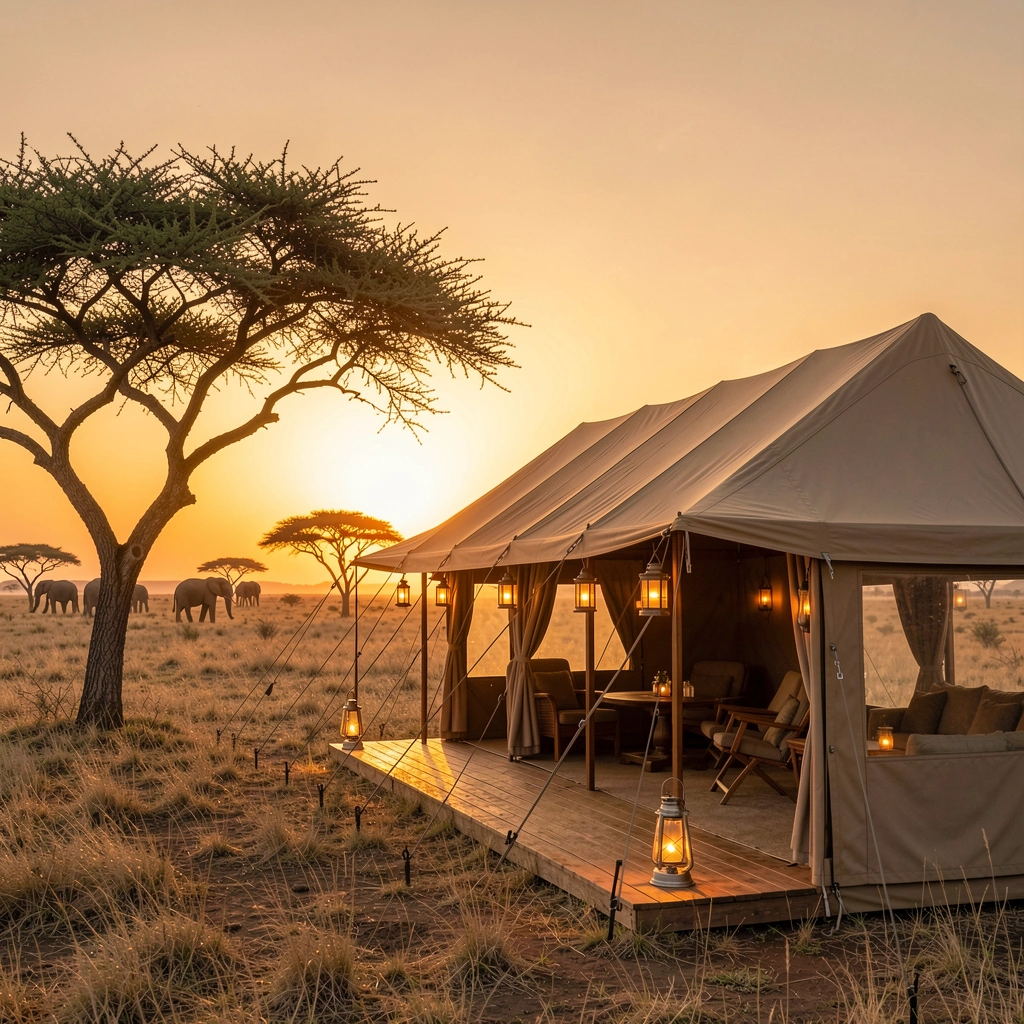
Camp quality: The finest safari camps — a canvas tent with a claw-foot bath positioned to look out over the bush, a plunge pool on the deck, a star bed (outdoor sleeping platform) rolled out at night for sleeping under the Southern Cross — offer a standard of both comfort and aesthetic that is genuinely world-class. Meals in the bush, often prepared by chefs who trained in fine dining and chose to come here for the environment, are routinely excellent.
Best Luxury Safari Camps And Lodges
Singita (multiple locations, Tanzania and South Africa): Singita is the benchmark against which other luxury safari operators are measured. Their camps in the Grumeti Reserve in Tanzania and the Sabi Sands in South Africa combine extraordinary architecture, exceptional food and wine, impeccable service, and guiding of the very highest quality. Rates typically run at £600 to £1,200 per person per night, all-inclusive including game drives.
Wilderness Safaris (Botswana, Namibia, Rwanda): The most respected safari operator in Botswana, with camps across the Okavango Delta including the celebrated DumaTau (for elephants) and Vumbura Plains (for wild dogs and general game). Their Rwanda property adjacent to the Volcanoes National Park is the finest base for gorilla trekking. Sustainability is built into everything they do.
Londolozi Private Game Reserve (Sabi Sands, South Africa): One of the founding properties of the luxury safari movement in South Africa, and still one of the finest. Their leopard-tracking programme is without peer — individual animals have been followed for multiple generations. The camps are beautiful, the guiding extraordinary.
Taj Safaris (India, Ranthambore and Jim Corbett): The Taj Hotel group’s safari properties in India combine the finest accommodation adjacent to India’s best tiger reserves with the Taj brand’s legendary service standards. Sher Bagh at Ranthambore is a tented camp of genuine style and comfort.
What Does A Luxury Safari Cost From The Uk?
India tiger safari (7 nights, including flights from London, accommodation at Ranthambore or Bandhavgarh, all game drives): from approximately £2,500 to £4,000 per person. This is our most popular entry point for UK safari travellers new to India.
Africa safari — East Africa (Kenya or Tanzania, 10 nights, including flights, mid-range luxury camps): approximately £4,000 to £6,500 per person. This tier accesses very good guides and camps in the Masai Mara or northern Serengeti.
Africa safari — Premium (Botswana Okavango Delta or South Africa Sabi Sands, 10 nights, top-tier private conservancy camps, private vehicle): approximately £7,000 to £12,000 per person.
Africa safari — Gorilla trekking Rwanda (3 to 5 nights, including flights from London, permit, and one of the luxury lodges adjacent to Volcanoes National Park): approximately £4,500 to £7,000 per person.
All prices are examples and vary significantly by season, camp, and routing. Call for a current personalised quote.
SAFARI PACKING GUIDE — WHAT TO BRING
Clothing: Neutral colours only. Khaki, olive green, beige, stone, and brown are ideal. White and bright colours disturb animals. Avoid camouflage (which can cause issues at some African borders). Layers are essential: dawn game drives in the Mara can be 8°C, while afternoon temperatures reach 30°C. Lightweight merino base layers, a fleece mid-layer, and a windproof outer are the practical combination.
Footwear: Sturdy walking shoes or ankle boots for walking safaris. Comfortable sandals for around camp.
Equipment: Quality binoculars are essential — minimum 8×42 magnification. Dust-proof camera with a telephoto lens of at least 400mm for wildlife photography (though the experience matters far more than the equipment). DEET insect repellent — very effective, very important for malaria-prevention alongside antimalarials.
Medical: Malaria prophylaxis is required for most safari destinations in Africa and for some in India. Consult your GP or a travel clinic at least six weeks before departure. A rehydration solution (Dioralyte or equivalent), antihistamines, and sunblock are all worth packing.
Book Your Luxury Safari With Superdestinations
Our safari consultants have first-hand experience of the destinations, camps, and experiences described in this guide. We build personalised safari packages — from a first-time India tiger safari combined with a Rajasthan tour to an extended Africa circuit across multiple countries — tailored to your interests, travel style, and budget.
Call 0203 727 6363 any day from 9:30am to 10pm, or WhatsApp us. Your quote is free, personalised, and backed by our ATOL licence 10713.