Saudi Arabia Luxury Holidays 2026: Riyadh, AlUla and the Red Sea from the UK
In 2019, Saudi Arabia opened its doors to international tourism for the first time in its modern history. In the years since, it has moved with extraordinary speed to build the infrastructure, hotels, and visitor experiences necessary to welcome the world. By 2026, it is one of the most compelling and dramatically undervisited luxury destinations accessible from the UK — a country of UNESCO-listed ancient cities, Red Sea coral reefs that rival the best in the world, dramatic desert landscapes, and a hospitality tradition that is genuinely one of the warmest on earth.
The transformation is real and it is rapid. AlUla — the ancient Nabataean city of Hegra, Saudi Arabia’s first UNESCO World Heritage Site — was opened to tourists only in 2020 and already hosts the internationally acclaimed Winter at Tantora cultural festival. The Red Sea Project is developing a chain of luxury eco-resorts on an entirely unvisited stretch of Saudi coastline. Riyadh’s contemporary art and gastronomy scenes have emerged from almost nothing to rival those of the Gulf’s more established destinations. And all of this at a price point that remains, for now, significantly below what the same quality of experience would cost in Dubai or the Maldives.
This guide covers what UK travellers need to know about visiting Saudi Arabia in 2026.
What this guide covers:
— Why Saudi Arabia is 2026’s most underrated luxury destination
— AlUla and the ancient wonder of Hegra
— Riyadh — a modern Arabian capital
— Jeddah and the Red Sea coast
— Practical travel information for UK tourists
— Package costs and what to expect
— Frequently asked questions
WHY SAUDI ARABIA SHOULD BE ON YOUR 2026 TRAVEL LIST
Saudi Arabia contains four UNESCO World Heritage Sites: the ancient Nabataean city of Hegra at AlUla (inscribed 2008, opened to tourists 2020), the historic city of Dir’aiyah on the outskirts of Riyadh (inscribed 2010), the Al-Ahsa Oasis in the Eastern Province (inscribed 2018), and the historic city of Jeddah (inscribed 2014). Each represents a layer of Arabian history that most travellers have never encountered.
Beyond the UNESCO designations, the country’s natural geography is extraordinary and largely unknown to international visitors. The Hisma Desert in the northwest, with its sandstone pillars and rock formations, resembles a Jordanian Wadi Rum transported to a larger scale. The Asir Mountains in the southwest receive enough rainfall to support terraced agriculture and juniper forests — a landscape entirely unlike the desert that most people associate with Saudi Arabia. The Red Sea coastline stretching from Jeddah south contains coral reef systems that marine biologists consider among the most pristine in the world, accessible from resorts and dive operations that did not exist five years ago.
The people are the final and perhaps most important reason. Saudi hospitality — the tradition of offering guests food, coffee, and dates before any business is discussed, the genuine interest in visitors from other cultures — is one of the most authentically warm in the world. Travellers who have visited recently consistently report a quality of welcome that exceeds expectation.
ALULA — SAUDI ARABIA’S ANCIENT WONDER
AlUla sits in a dramatic desert valley in northwest Saudi Arabia, 350 kilometres from the nearest major city. The valley is extraordinary in itself — a lush oasis of date palms and ancient mud-brick settlements at the foot of towering sandstone escarpments, in a landscape that has been continuously inhabited for at least 7,000 years.
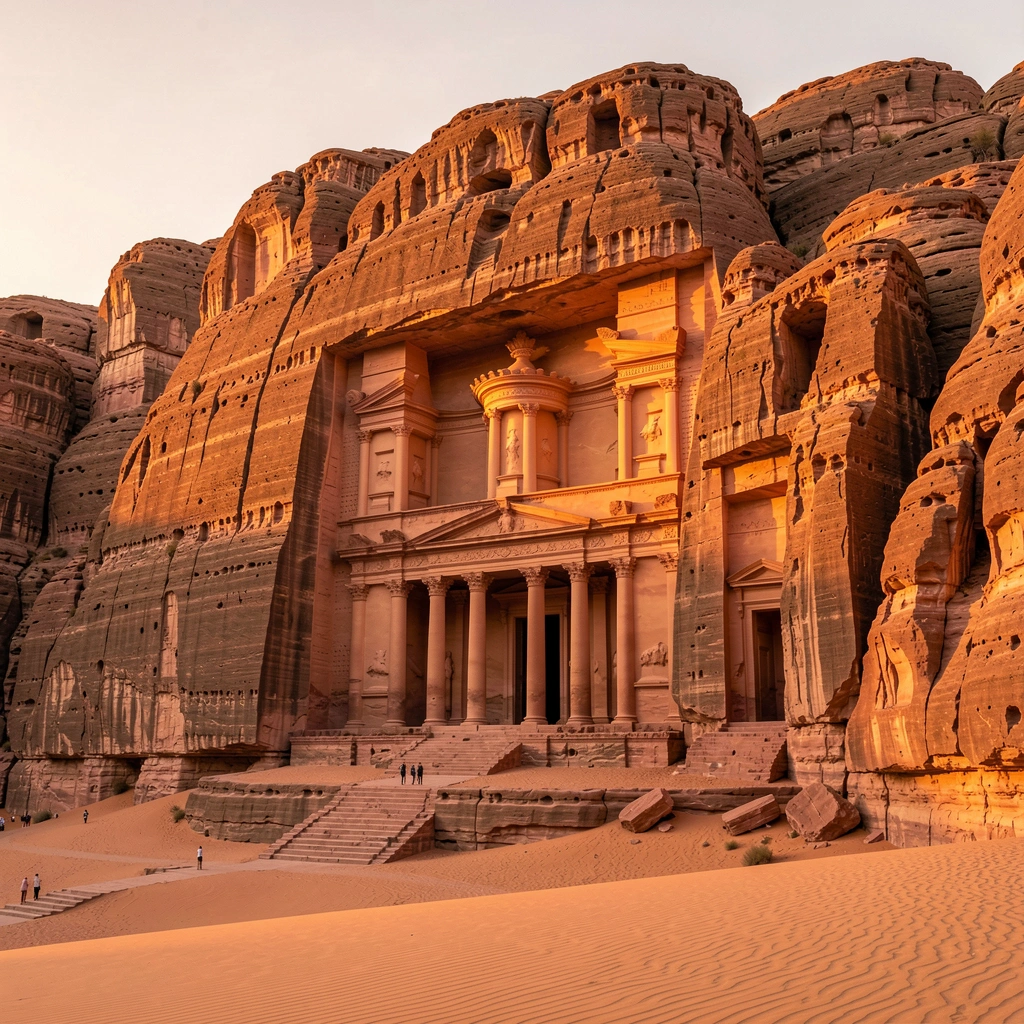
The principal attraction is Hegra (also known as Mada’in Salih) — the first UNESCO World Heritage Site in Saudi Arabia and one of the most significant Nabataean archaeological sites in the world. The Nabataean civilisation, which also created Petra in Jordan, carved its funeral monuments directly into the rose-red sandstone cliffs here between approximately 100 BCE and 100 CE. There are 131 tombs at Hegra, their facades elaborately carved with eagles, inscriptions, and architectural details, towering above the desert floor. Unlike Petra — which receives more than a million visitors per year — Hegra in 2026 receives a fraction of that number, and it is possible to visit at dawn with almost no one else present. The scale and state of preservation are remarkable.
The wider AlUla region contains additional sites of extraordinary significance. Dadan is an even older city, predating the Nabataeans, with its own carved tombs and a layer of Lihyanite civilisation that extended from approximately 800 BCE. Jabal Ikmah is described as an open-air library — a sandstone hillside covered in thousands of inscriptions in Dadanite, Lihyanite, Nabataean, and other ancient scripts, documenting commercial transactions, prayers, and personal records over 2,000 years.
The AlUla experience has been developed thoughtfully. Guided jeep tours through the desert are excellent, led by knowledgeable Saudi guides. Hot air balloon flights at dawn offer extraordinary views over the sandstone formations and oasis valley. The Winter at Tantora cultural festival (October to March) brings international artists and musicians to perform in the desert. The Banyan Tree AlUla and the Shaden Resort are the finest accommodation options, both offering an architectural approach that complements rather than overwhelms the extraordinary landscape.
The practical note on timing: AlUla is in the high desert and summers (May to September) bring temperatures exceeding 45°C. The optimal visiting window is October to April.
RIYADH — A MODERN ARABIAN CAPITAL
Riyadh, Saudi Arabia’s capital, is a city of dramatic contrasts — one of the world’s youngest major cities in terms of its modern built fabric, but one of the oldest in terms of its heritage.
Dir’aiyah, on the northwestern edge of Riyadh, is the UNESCO-listed mud-brick city that was the first capital of the Saudi state in the 18th century. The Al Turaif district, built from the earth-toned mudbrick that characterises Najdi architecture, is being restored to extraordinary effect. The Evening at Ad Diriyah experience — illuminated night visits through the restored old city, with theatrical installations and traditional food and performance — is one of the most compelling cultural experiences in the contemporary Middle East.
The Edge of the World (Jebel Fihrayn) is an escarpment 40 kilometres outside Riyadh where the Arabian Plateau drops vertically 300 metres to a vast alluvial plain stretching to the horizon. On a clear day the view extends 75 kilometres. The site is reachable by 4WD on a two to three hour guided excursion from the city and provides one of the most dramatic natural panoramas in the region.
In the city itself, the Al Faisaliyah Tower observation deck offers a 360-degree view over Riyadh’s skyline. The National Museum of Saudi Arabia, housed in a building beside the Murabba Palace, is a serious and beautifully presented institution covering the full arc of Arabian history. The Masmak Fortress in the old city centre was the site of the 1902 battle in which the young Abdulaziz ibn Saud began the conquest that led to the creation of modern Saudi Arabia.
For dining and luxury hotels, Riyadh has transformed in recent years. The Four Seasons Riyadh at Kingdom Centre occupies the upper floors of the 302-metre Kingdom Tower, with views over the entire city. The Waldorf Astoria Riyadh opened recently to widespread acclaim. The restaurant scene — particularly in the Riyadh Season (October to March) entertainment calendar — now extends to genuine fine dining of international calibre.
Jeddah And The Red Sea Coast
Jeddah is Saudi Arabia’s port city, its commercial hub, and in many ways its most cosmopolitan and open-minded city. Unlike Riyadh — which is an inland desert capital — Jeddah faces the Red Sea and has been shaped by centuries of maritime trade with East Africa, India, and the Mediterranean.
Al-Balad, Jeddah’s UNESCO-listed old city, is one of the most architecturally extraordinary urban environments in the Arab world. Built primarily in the 18th and 19th centuries from coral stone quarried from the Red Sea, its four to five storey merchant houses are decorated with elaborate wooden mashrabiyya lattice screens that both ventilate and provide privacy. Walking through Al-Balad at dusk, when the coral stone takes on a golden colour and the muezzin call echoes between the buildings, is an experience of rare atmospheric beauty.
The Red Sea diving and snorkelling is the final and arguably most important reason to include Jeddah in an itinerary. Marine biologists who have worked in both the Red Sea and the Indo-Pacific consistently describe Saudi Red Sea sites as among the most pristine and diverse they have encountered — coral systems largely undisturbed by mass tourism, extraordinarily clear water, and marine biodiversity that includes whale sharks, manta rays, dolphins, dugongs, and hundreds of species of reef fish. Dive operations accessible from Jeddah are now well-established, and the Red Sea Project development further south is creating luxury eco-resort infrastructure on an even more remote section of this extraordinary coast.
King Fahd Fountain, just off the Jeddah Corniche, is the world’s tallest fountain — reaching 312 metres at full height, illuminated at night in white and gold light over the Red Sea. It is visible from most of the city’s higher points and serves as a spectacular signature of Jeddah’s skyline.
Saudi Arabia Travel Practicalities For Uk Tourists
Visa: The Saudi tourist eVisa is available online at visa.visitsaudi.com. The application takes approximately 10 minutes, costs approximately £95 per person, and is valid for one year with multiple entries, 90 days per visit. It is processed within minutes in most cases. UK citizens have been eligible for the tourist eVisa since 2019.
Dress: Saudi Arabia no longer requires tourists to wear abaya or cover their heads in public spaces. Modest clothing — covering shoulders and knees — is respectful and recommended in religious sites and markets. The standard in international hotels, restaurants, and shopping centres in Riyadh and Jeddah is broadly comparable to any Gulf destination.
Alcohol: Alcohol is not available anywhere in Saudi Arabia, including in hotels. This is a firm rule with no exceptions. Travellers who find this a dealbreaker should visit another destination.
Currency: The Saudi riyal trades at approximately 4.8 to the pound. Visa and Mastercard are accepted universally in hotels, restaurants, and most retail. Cash is available at ATMs throughout major cities.
Safety: Saudi Arabia is consistently rated among the safest countries in the world for tourists. Violent crime rates are extremely low. The political environment is stable. Travel within the main tourist regions — Riyadh, Jeddah, and AlUla — is straightforward and comfortable.
Photography: Standard travel photography is welcome throughout Saudi Arabia. Avoid photographing government buildings, military installations, and individuals without permission.
Saudi Arabia Package Costs From The Uk
Our 7-night Riyadh and Jeddah package starts from £2,929 per person including return flights from London and four and five star accommodation. This package covers the main cultural highlights of both cities.
Our 11-night full Saudi Arabia tour — Riyadh, AlUla, and the Red Sea — starts from £7,349 per person. This is a comprehensive journey through the country’s three most significant regions, with accommodation at the finest properties in each, private guides throughout, and all transfers included. It represents excellent value given the quality of the hotels and the extraordinary nature of what it covers.
All prices are examples and vary by season and availability.
Book Your Saudi Arabia Holiday With Superdestinations
Saudi Arabia is genuinely the most exciting new luxury destination accessible from the UK, and one we know in considerable depth. Our consultants can build bespoke itineraries combining any combination of Riyadh, Jeddah, and AlUla, with the option to add a Red Sea diving extension or a Maldives add-on via the Doha hub.
Call 0203 727 6363 any day from 9:30am to 10pm, or send a WhatsApp. Your quote is free, personalised, and backed by ATOL 10713.