India Luxury Tour Packages from the UK 2026: Golden Triangle, Rajasthan and Beyond
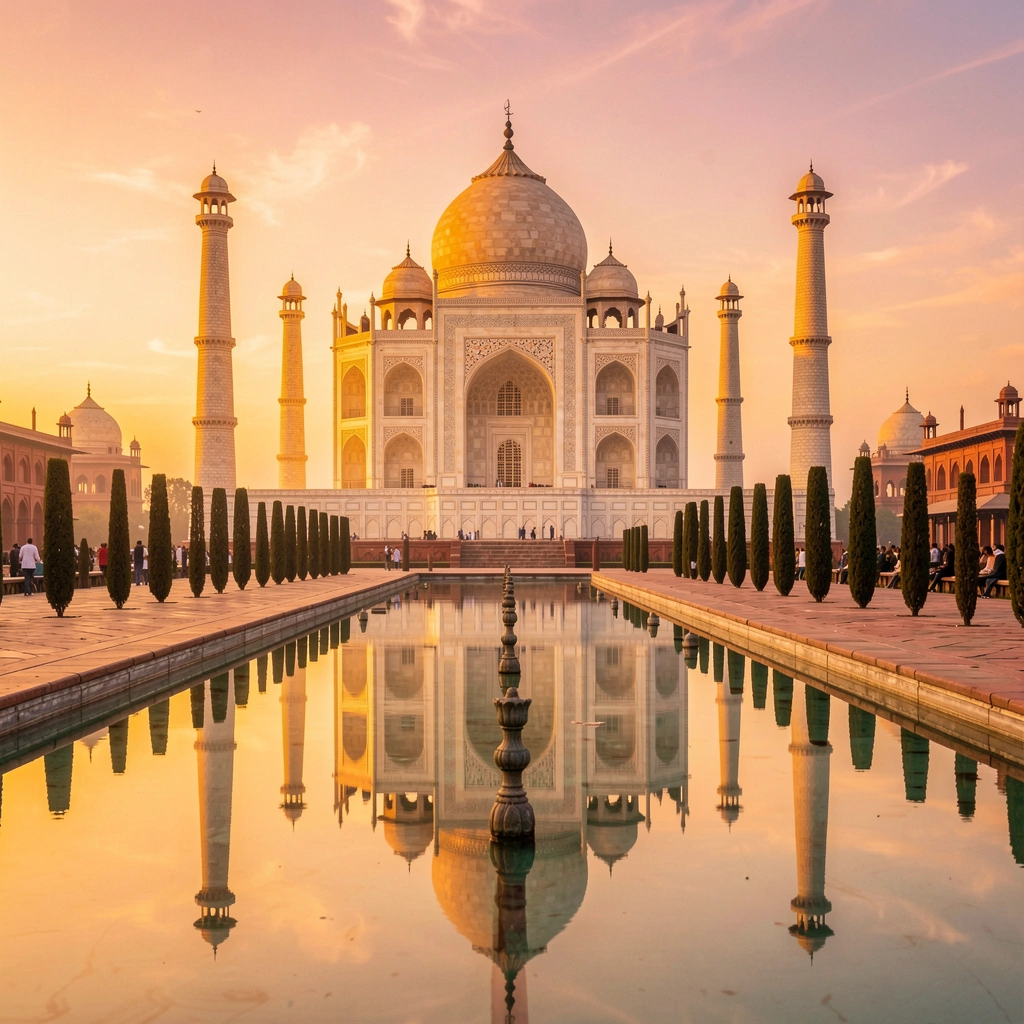
India is not a destination. It is an experience — an immersion in something so vast, so layered, so simultaneously ancient and chaotically modern that no other country on earth quite prepares you for it. The smell of jasmine and diesel at a Jaipur street corner. The Taj Mahal at dawn, rose-gold in the first light, its reflection shimmering in the still central pool. A Bengal tiger moving through the teak forest at Ranthambore, 40 metres from your open jeep. A heritage palace hotel in Udaipur where you sleep in the room where a maharaja held court a century ago.
For UK travellers willing to move beyond the familiar comforts of beach holidays, India offers something that cannot be replicated anywhere else: a complete sensory and intellectual education, delivered alongside some of the most extraordinary luxury hospitality in the world. India’s palace hotel circuit — converted royal residences of the Rajput maharajas and Mughal-era nobles — represents a category of accommodation that exists nowhere else. And the wildlife safari circuit, particularly for Bengal tiger sightings, is world-class and dramatically more accessible from the UK than its African equivalents.
This guide covers the main routes and regions for a luxury India tour from the UK in 2026.
What this guide covers:
— The Golden Triangle explained
— Rajasthan’s luxury palace circuit
— Wildlife safari India — best parks and seasons
— South India — Kerala, Goa, and Tamil Nadu
— Best time to visit
— Getting there from the UK
— Pricing at every tier
— Frequently asked questions
The Classic Golden Triangle Explained
The Golden Triangle is the most established luxury tour circuit in India, connecting three cities that collectively represent the country’s greatest concentration of Mughal and Rajput heritage: Delhi, Agra, and Jaipur. The circuit is named for the rough triangle these three cities form on the map, each approximately 200 to 250 kilometres from the others.
Delhi is India’s capital and its most cosmopolitan city. The old and new halves of the city are dramatically different in character. Old Delhi — Shahjahanabad, the Mughal walled city — is a sensory assault: the spice traders of Khari Baoli, the perfume sellers of Dariba Kalan, the labyrinthine lanes of Chandni Chowk, and the magnificent Jama Masjid mosque, one of the largest in India. A food walk through Old Delhi at dusk is among the great culinary experiences anywhere in Asia. New Delhi — Lutyens’ Delhi, the colonial capital designed by Edwin Lutyens — is a different world: wide tree-lined avenues, imperial architecture, embassies, and excellent restaurants. Humayun’s Tomb, a 16th-century Mughal mausoleum that predates and clearly influenced the Taj Mahal, is outstanding and significantly less crowded.
Agra needs only one introduction: the Taj Mahal. Shah Jahan commissioned it between 1631 and 1648 as a mausoleum for his wife Mumtaz Mahal, who died in childbirth with their 14th child. The result is the most perfectly symmetrical building ever constructed, and one of those rare landmarks that genuinely exceeds its reputation. The key is timing: arrive at the earliest possible entry — the first shuttle from Agra at dawn — to experience the Taj with a fraction of the day’s visitors and in the extraordinary pink-gold light of early morning. The reflection in the central channel at this hour is the defining photograph of India. The nearby Agra Fort and the abandoned Mughal capital of Fatehpur Sikri (40 kilometres west) are also significant and often overlooked by visitors focused entirely on the Taj.
Jaipur, the Pink City, was built in 1727 by Maharaja Jai Singh II and has been painted a distinctive terracotta pink since 1876. The old walled city is a working city as well as a heritage destination — its bazaars sell textiles, gems, jewellery, and block-printed fabrics that have been traded here for centuries. The Amber Fort, perched on a hillside 11 kilometres from the city centre, is one of Rajasthan’s finest palaces. The Hawa Mahal — the Palace of Winds, a five-storey facade of 953 small windows designed to allow royal women to observe street life without being seen — is the most photographed image in Jaipur.
The circuit works best with a minimum of seven nights — two in Delhi, two in Agra, two to three in Jaipur — though 10 nights allows for a more comfortable pace with time for cooking classes, day trips, and the luxury of not feeling rushed. Travel between cities can be by private air-conditioned car (three to four hours between cities) or by train — the Gatimaan Express between Delhi and Agra is fast and comfortable.
RAJASTHAN — INDIA’S LUXURY PALACE CIRCUIT
Rajasthan is where Indian luxury travel reaches its pinnacle. The desert state to the west of Jaipur is home to a chain of extraordinary cities — each with its own maharaja’s palace, its own fort, its own character — that form one of the world’s great cultural road trips.
Udaipur is widely considered the most romantic city in India, and the claim is not hard to understand. Built around a series of lakes, with the City Palace rising above the water and the Aravalli Hills providing a backdrop, Udaipur has an atmosphere of contained grandeur. The Taj Lake Palace — a white marble palace that appears to float on Lake Pichola — is one of the most celebrated hotel addresses in the world. Arriving by boat at sunset, the palace glowing above its own reflection, is genuinely extraordinary. The Oberoi Udaivilas, a newer property on the lake shore, rivals it for beauty and surpasses it for the contemporary quality of its service and food.
Jodhpur is the Blue City — its old town is painted a distinctive azure blue, a tradition rooted in the caste traditions of the Brahmin community. The Mehrangarh Fort, rising above the city on a sheer rocky outcrop, is arguably the finest fort in India: massive, beautiful, and with extraordinary panoramic views over the blue rooftops below. The RAAS hotel, built into the old city walls with direct views up to the fort, is one of the most architecturally inventive heritage hotels in Rajasthan.
Jaisalmer is the furthest and most extraordinary. A sandstone fort city rising out of the Thar Desert, it looks as though it was assembled from honey-coloured blocks and placed at the edge of the world. The Jaisalmer Fort is a living fort — people still live, shop, and worship within its walls. The desert outside the city offers camel trekking, jeep safaris, and overnight stays in luxury desert camps beneath a sky unpolluted by city lights. This is India at its most cinematic.
The palace hotels of Rajasthan deserve special mention. These are not hotels that have been designed to look like palaces — they are actual palaces, converted from royal use to hospitality use over the past 50 years. The Taj family (Rambagh Palace in Jaipur, Lake Palace in Udaipur), the Oberoi family (Udaivilas), and independent properties like SUJÁN Jawai and Raas Devigarh all offer accommodation in genuinely historic royal buildings. The experience of sleeping in a room that was furnished for a maharaja — surrounded by original architecture, art, and gardens — is available only in Rajasthan, and it is extraordinary.
WILDLIFE SAFARI INDIA — TIGER COUNTRY
India has a larger wild Bengal tiger population than any other country on earth, and its network of national parks offers genuinely world-class wildlife safari experiences that most UK travellers have never considered.
Ranthambore National Park, in Rajasthan, is the most accessible tiger reserve for UK visitors combining a Rajasthan cultural tour with wildlife. The park sits around the ruined medieval Ranthambore Fort — the most photographed tiger habitat in the world, where images of tigers against ancient fort architecture are iconic. The tigers of Ranthambore have had limited human contact for decades and are relatively habituated to vehicles, making sightings more reliable than in more remote parks. Safari jeeps depart twice daily — at dawn and mid-afternoon. A two-night stay here is easily incorporated into the end of a Rajasthan itinerary.
Bandhavgarh National Park in Madhya Pradesh has the highest density of Bengal tigers in India and consistently delivers the best sighting rates. Less convenient to reach from Rajasthan (domestic flight to Jabalpur, then a three-hour road transfer), it is the preferred destination for serious wildlife photographers and travellers who have already seen Ranthambore.
Jim Corbett National Park in Uttarakhand is India’s oldest national park, established in 1936, set in the foothills of the Himalayan range. The approach by road from Delhi through increasingly dramatic mountain scenery is itself a pleasure. Corbett is known for its elephant population as well as tigers, and the forest ecosystem is distinctly different from the scrubby deciduous woodland of Ranthambore.
Kaziranga National Park in Assam is a UNESCO World Heritage site and home to two-thirds of the world’s entire greater one-horned rhinoceros population. An elephant safari through the tall grass at dawn in Kaziranga is one of the most unusual wildlife experiences in Asia.
Best conditions for wildlife sightings are October to April, when water sources concentrate animals at predictable locations and the vegetation has thinned sufficiently for clear views. The monsoon (July to September) closes most national parks.
SOUTH INDIA — A DIFFERENT LUXURY ENTIRELY
North India’s Golden Triangle and Rajasthan circuit dominates the imagination, but South India offers a categorically different experience that many UK travellers never discover.
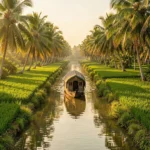
Kerala, in the southwestern corner of the subcontinent, is best known for its backwaters — a network of interconnected rivers, lakes, and canals stretching for 900 kilometres through a landscape of coconut palms, rice paddies, and fishing villages. Spending one to two nights on a traditionally styled houseboat (kettuvallam) — converted from the rice barges that once worked these waters — drifting through the backwaters is one of the most peaceful travel experiences in India. Kerala also offers some of the finest Ayurvedic spa traditions in the world, with treatments that are genuinely rooted in traditional medicine rather than resort approximations.
Goa sits on India’s western coastline, 400 kilometres south of Mumbai. Its Portuguese colonial heritage gives it a distinct character from the rest of India — Baroque churches, whitewashed mansions, and a food culture shaped by four centuries of Portuguese occupation. The St Regis Goa Resort on the Cansaulim coast is the finest luxury hotel in the state, with a 700-metre private beachfront and a level of service that would earn stars anywhere in the world. Goa combines well with Rajasthan or the Golden Triangle as a final destination for beach recovery before flying home.
Tamil Nadu in the deep south contains some of the most extraordinary ancient temple architecture in India — Meenakshi Amman Temple in Madurai, Brihadeeswarar Temple in Thanjavur, and the Shore Temple at Mamallapuram, standing on the beachfront of the Bay of Bengal. The Chettinad region, homeland of the Chettiar mercantile community, contains palatial mansions built from teak and Italian marble in the 18th and 19th centuries. Several have been converted to extraordinary boutique hotels.
Best Time To Visit India From The Uk
October to March is the recommended window for North India — the Golden Triangle and Rajasthan circuit. Temperatures are comfortable, typically 15 to 25°C in daytime with cool evenings in the desert. Skies are clear. The light is exceptional for photography. This is peak season and prices for the finest palace hotels can reflect that.
April to June brings extreme heat to North India — temperatures in Rajasthan regularly exceed 40°C. With appropriate preparation (early morning and late afternoon activity, air-conditioned transfers), it remains possible, but it is not comfortable. The hill station resorts of the Aravalli Hills offer some relief.
July to September is the monsoon. In Rajasthan, the rains are a relief after the summer heat and the landscape transforms to vivid green. Udaipur’s lakes fill dramatically. But travel logistics can be complicated by rain. The Kerala monsoon (June to August) is, by contrast, extraordinary — not oppressive but lush, dramatic, and the best possible time for Ayurvedic treatments.
Diwali — the festival of lights — falls in October or November (the date changes each year). Celebrating Diwali in Jaipur or Udaipur is one of the most extraordinary cultural experiences available to UK travellers: the old city lit by thousands of oil lamps and clay diyas, fireworks over ancient forts, the sense of an entire civilisation celebrating together.
Getting To India From The Uk
British Airways and Virgin Atlantic both operate direct flights from London Heathrow to Delhi (approximately nine hours) and Mumbai (approximately nine and a half hours). Indirect routes via Dubai (Emirates), Doha (Qatar Airways), and Abu Dhabi (Etihad) are available from regional UK airports including Manchester, Edinburgh, Birmingham, and Glasgow.
Domestic flights within India are operated primarily by IndiGo and Air India at low cost, making it practical to fly between cities rather than spend days on road transfers. A Delhi to Udaipur flight, for example, is one and a half hours — covering a journey that would take 12 hours by road.
UK citizens require an eVisa for India, which is available online through the official Indian government visa portal. The eVisa application is straightforward, takes approximately 10 minutes to complete, and is typically processed within 72 hours. The cost is approximately £25. Apply at least one week before travel.
What Does A Luxury India Holiday Cost From The Uk?
Entry luxury (£2,000 to £3,000 per person, 10 nights including flights): A Golden Triangle itinerary with three to four star hotels, private driver and guide, airport transfers, and most entrance fees. This is our starting point for India tours and it delivers an excellent experience.
Premium palace circuit (£3,000 to £5,000 per person): Full Rajasthan circuit including Jaipur, Jodhpur, Jaisalmer, and Udaipur in four to five star palace hotels, private driver and expert guide, wildlife safari extension in Ranthambore. This is the signature India luxury experience.
Extended tour (£4,000 to £6,500 per person): Combined Golden Triangle, full Rajasthan circuit, and wildlife safari or Goa beach extension. Fifteen nights minimum.
All prices include return flights from a UK airport and are examples — prices vary by season, hotel selection, and availability.
Book Your India Luxury Tour With Superdestinations
Our India specialists have first-hand knowledge of the routes, hotels, and experiences described in this guide. We build personalised India tours — from Golden Triangle weekenders to extended palace and safari circuits — tailored to your travel style, pace, and budget.
Call 0203 727 6363 any day from 9:30am to 10pm, or send us a WhatsApp message. Your quote is free, fully personalised, and backed by our ATOL licence 10713 and 4.9-star Trustpilot rating.