Luxury Kerala holidays follow a well-worn loop through India’s south-western state. A houseboat cruise on the Alleppey backwaters sits alongside Munnar’s tea country, the spice hills of Periyar and a hotel on the Arabian Sea. It is the gentler, greener side of holidays across India, and the whole circuit fits into a fortnight or less.
Quick answer
Luxury holidays to Kerala from the UK usually run 10 to 13 nights, or 14 on the wider South India tour. Prices start from £1,439 per person, based on two sharing, with return flights from the UK included. November to February is the driest window. UK passport holders need an Indian e-Visa and an e-Arrival card. ATOL 10713 protected.
- Flight time from London
- About 12 to 14 hours to Kochi.
- Time difference
- 5 hours 30 minutes ahead of GMT, 4 hours 30 minutes ahead of BST.
- Local language
- Malayalam, with English widely used in hotels.
- Currency
- Indian rupee (INR).
What does a luxury Kerala holiday include?
Our three Kerala tours share the same core: Kochi, Munnar, Thekkady, the Alleppey backwaters and a beach. They differ in the extra stops, the hotels, the beach you finish on and the airport you fly home from. The table sets out each tour stop by stop.
| Stop | 10-night tour | 11-night tour | 13-night tour | What you do there |
|---|---|---|---|---|
| Kochi | Yes | Yes | Yes | Old Kochi sightseeing: the Jewish Synagogue and Chinese fishing nets on the 10- and 11-night tours, Fort Kochi and Mattancherry on the 13-night tour |
| Muvattupuzha | Yes | – | – | A quiet riverside stop where three rivers meet |
| Munnar | Yes | Yes | Yes | Tea estates, the tea museum and hill viewpoints |
| Thekkady (Periyar) | Yes | Yes | Yes | Lake boat trip in the reserve and spice plantations |
| Alleppey houseboat | Yes | Yes | Yes | Cruising the canals and lake on a converted rice barge |
| Kollam (Paravur) | – | – | Yes | A second, quieter backwater area: a mangrove boat trip, bird and butterfly watching and a Keralan cookery demonstration |
| Beach | Marari | Poovar | Varkala, then Kovalam | Rest, pool and spa time |
| Fly home from | Kochi | Thiruvananthapuram | Thiruvananthapuram | – |
Each move between stops is a private road transfer with a driver, usually after breakfast. Munnar is about 119 km from Cochin International Airport, and the climb into the Western Ghats is slow on mountain roads. Allow a morning for it rather than an hour.
The order rarely changes, because it follows the geography. Kochi sits on the coast, the hills rise to the east, and the backwaters and southern beaches lie on the way back down towards the sea. Travelling in a loop means you never cover the same road twice.
The Kerala backwaters: what a houseboat night is really like
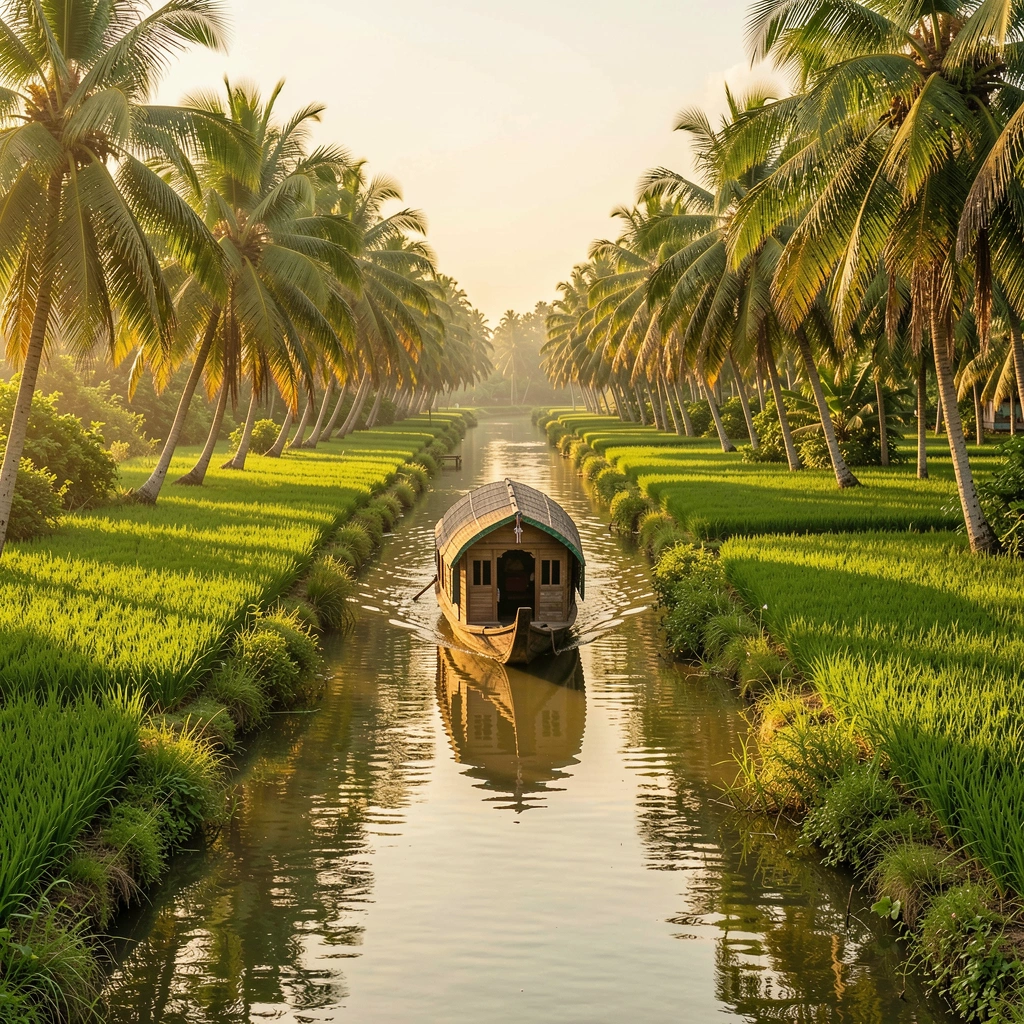
The houseboats are converted kettuvallams. These barges once carried up to 30 tons of rice and spices from Kuttanad to the port at Kochi. Kerala Tourism describes the hull as jack-wood planks joined with coir and coated in a black resin made from boiled cashew kernels. Modern boats add bedrooms, toilets and a kitchen under a curved roof of bamboo matting.
Alleppey (Alappuzha), the usual base for Kerala backwaters holidays, sits on the southern edge of Vembanad Lake, Kerala’s largest lake at 2,033 sq km. The wider network of lakes, canals and rivers runs for more than 900 km behind the coast. Houseboats also operate from Kollam, Kottayam, Kochi and several other districts.
On all three of our Kerala tours the houseboat is private, and the stay is one night. You drive down from Thekkady, board at Alleppey, cruise the backwaters and wake up on the water. On the 10- and 13-night tours the itinerary includes breakfast on board before you step off and continue by road.
Munnar tea estates and the Western Ghats
Munnar sits between roughly 1,500 and 2,500 metres in the Western Ghats. Tea planting began here in 1880, and the Kannan Devan Hills estates still cover much of the landscape. The Tata Tea Museum at Nallathanni Estate explains how the leaf is processed and opens from 10am to 5pm.
Above the town, Eravikulam National Park protects the Nilgiri tahr, an endangered mountain goat of the Western Ghats. Anamudi, at 2,695 metres, rises inside the park. The park closes every February and March while the tahr give birth. A Munnar day in those months uses tea estates, the museum and viewpoints such as Mattupetty Dam and Echo Point instead.
The hills also produce neelakurinji, a shrub that turns the slopes blue once every 12 years. The last bloom was in 2018 and the next is expected in 2030.
Our tours stay at Tea Harvester, Fragrant Nature Munnar or The Tall Trees, all set among the estates rather than in the busy town centre.
Periyar and Thekkady: spice gardens and wildlife
Thekkady is the town at the gate of the Periyar Tiger Reserve, a forested reserve around a lake created by a dam. The main activity is a boat trip on Periyar Lake, looking for elephants, deer and water birds along the banks. Tigers live in the reserve, but treat the boat trip as a wildlife cruise rather than a tiger safari.
The hills around Thekkady grow cardamom, pepper and other spices, and plantation walks are the other main activity. Hotels here are hillside resorts in the trees: Spice Village, Greenwoods Resort and Cardamom County by Xandari feature on our tours.
Kerala beach resorts: Marari, Varkala, Kovalam and Poovar
The beach stay is where the tours differ most. Kerala’s coast runs south from Marari towards the tip of India, and each beach has a different character.
| Beach | Feel | Where you stay |
|---|---|---|
| Marari | Quiet fishing-village beach north of Alleppey, with the resort set in coconut groves | Marari Beach (CGH Earth) |
| Poovar | An estuary where the river meets the sea | Isola Di Cocco |
| Varkala | Red laterite cliffs above the beach, with cafés along the cliff path | A daytime stop on the drive south |
| Kovalam | The most developed resort beach, busier, with more restaurants and shops | The Travancore Heritage |
Ayurveda in Kerala: how to choose a genuine centre
Ayurveda is Kerala’s traditional system of medicine. The massages and oil treatments on a hotel spa menu are relaxing, but they are not a course of treatment.
Panchakarma, the full programme, runs in three stages according to Kerala Tourism. Purvakarma prepares the body with oil and heat, Pradhanakarma is the main cleansing treatment, and Paschatkarma is a recovery plan of diet, rest and lifestyle changes. That takes a dedicated stay, not an afternoon at the spa.
Before you book a longer programme, check that the centre appears in Kerala Tourism’s accredited list, graded Green Leaf or Olive Leaf. Then ask three questions. Who carries out the first consultation, and are they a qualified Ayurvedic doctor? How many days does the programme need? What is the diet during treatment? A clear answer to all three is a good sign.
On our tours, the 11-night itinerary includes one complimentary Ayurvedic treatment at Poovar. The resort at Marari offers yoga and meditation sessions on the 10-night tour.
When is the best time to visit Kerala from the UK?
Kerala gets two monsoons. The south-west monsoon normally reaches the coast around 1 June. The north-east monsoon follows from October to December, with shorter and lighter showers.
| Months | Weather | Backwaters | Munnar |
|---|---|---|---|
| October | Green after the rains, humid | Good, with water levels high | Misty and lush |
| November to February | Driest and most comfortable | Best of the year | Clear, dry days |
| March to May | Hot and humid, building towards the monsoon | Still fine, very warm | Welcome relief from the coastal heat |
| June to September | Heaviest rain of the year | Not recommended | Wet and often cloudy |
November to February is also peak season, so book hotels early for Christmas and New Year.
The snake-boat races are the one reason to go in the monsoon. The Nehru Trophy on Punnamada Lake near Alleppey is the best known. The 2026 race took place on 22 August, and the 2027 date has not been announced.
How do you get to Kerala from the UK?
No non-stop London to Kochi flight is currently scheduled, so every route connects through a Gulf or Indian hub. Our three Kerala tours land at Cochin International Airport. The connection time decides how long the journey feels, so compare it as closely as the fare when you look at quotes.
How much does a luxury Kerala holiday cost from the UK?
These are our current Kerala and South India tours. Each price is for the lowest available month from October 2026 onwards, on a two-sharing basis with flights. Dates, airport and cabin change the price.
| Tour | Nights | From, Economy | From, Business |
|---|---|---|---|
| Luxury Kerala Tour | 10 | £1,899pp | £4,189pp |
| Kerala: India’s Spice Coast | 11 | £1,439pp | £3,079pp |
| Enchanting Kerala | 13 | £1,879pp | £3,879pp |
| South India: temples, wildlife and backwaters | 14 | £2,949pp | On request |
The lowest Economy price for the 10-, 13- and 14-night tours applies in both May and June 2027. The 11-night tour’s lowest month is November 2026.
The 14-night tour starts in Bangalore and covers Mysore, the Kabini and Nagarhole wildlife areas and the hill stations of Ooty and Coonoor. It then crosses into Kerala for Kochi and Alleppey and finishes with a beach stay at Marari before the flight home from Kochi.
Entry requirements for UK passport holders
- Visa: British citizens need a visa unless they hold OCI status. Apply for an e-Tourist visa at indianvisaonline.gov.in at least 4 days before arrival and no more than 120 days ahead.
- Fees for UK nationals: a 30-day e-Tourist visa is US$10 for arrivals between April and June, and US$25 from July to March. Longer options cost US$40 for one year and US$484 for five, with a 3% bank charge on top of every fee.
- Passport: valid for at least 6 months after arrival, with at least 2 blank pages.
- e-Arrival card: complete it online in the 72 hours before you land.