A Cape Town and Kruger safari combines a stay in the city and the Cape Winelands with a guided safari in a private reserve, linked by a domestic flight. It puts a South Africa safari and city holiday into one trip. This guide explains how the trip fits together, what it costs by month from the UK, which seasons suit each half and what to sort out before you fly.
Quick answer
Our Cape Town and Kruger safari package from the UK is a 9-night holiday: Cape Town first, then a Sabi Sand safari lodge, home from Johannesburg. It costs from £5,919pp in Economy or £10,299pp in Business for October 2026 departures. Return flights from London and the internal flights are included. The direct London to Cape Town flight time is about 11.5 hours. ATOL 10713 protected.
- Time difference
- South Africa Standard Time is UTC+2 with no daylight saving: 1 hour ahead of the UK in summer, 2 hours ahead in winter.
- Entry for UK passports
- No visa for stays of up to 90 days. Your passport needs at least 30 days’ validity after you leave and 2 blank pages.
- Malaria
- Kruger and the low-lying Lowveld have a transmission season from September to May. Cape Town has no malaria.
- Cape Town to Kruger flight
- About 2 hours non-stop.
How a Cape Town and Kruger safari holiday works
Our Cape Town and Kruger safari package is built as an open-jaw trip. You fly from London into Cape Town and home from Johannesburg, with two domestic hops in between.
| Stop | Days | Hotel |
|---|---|---|
| Cape Town | 1–4 | One&Only Cape Town, V&A Waterfront |
| Sabi Sand | 5–7 | Lion Sands River Lodge |
| Johannesburg | 8 | InterContinental Johannesburg OR Tambo Airport |
| Flight home | 9 | None. |
Running the Cape first and leaving from Johannesburg means nobody flies back down to the Cape at the end. The lodge stay finishes with a short flight west to Johannesburg, the main international gateway. A night at the airport hotel then separates the bush from the long-haul leg. That buffer matters if the flight out of the Lowveld runs late, because you are not connecting to the UK flight on the same day.
Cape Town: what the city days cover
The first afternoon is free after the airport transfer. The Peninsula day is spent with a guide. The road runs south through the fishing harbours of False Bay to Cape Point and the Cape of Good Hope, the rocky tip inside Table Mountain National Park. On the way back you stop at Boulders Beach, where a colony of African penguins breeds on the sand. Lunch is in Simon’s Town, the old naval port. The return usually follows Chapman’s Peak Drive, a cliff road cut above the Atlantic.
Table Mountain gets its own morning. Check the cableway operator’s opening hours for your date before you go. It shuts when the wind is too strong, so keep the rest of that day loose. Tickets bought online stay valid for seven days, which lets you move the ride to the next clear morning. The afternoon is free. Robben Island, where Nelson Mandela was held, is an optional extra that departs from the Waterfront.
The Winelands day heads inland. A guide takes you to three wine estates with lunch at one of them, then drives you back to the city for the evening.
Kruger safari: the Sabi Sand private reserve
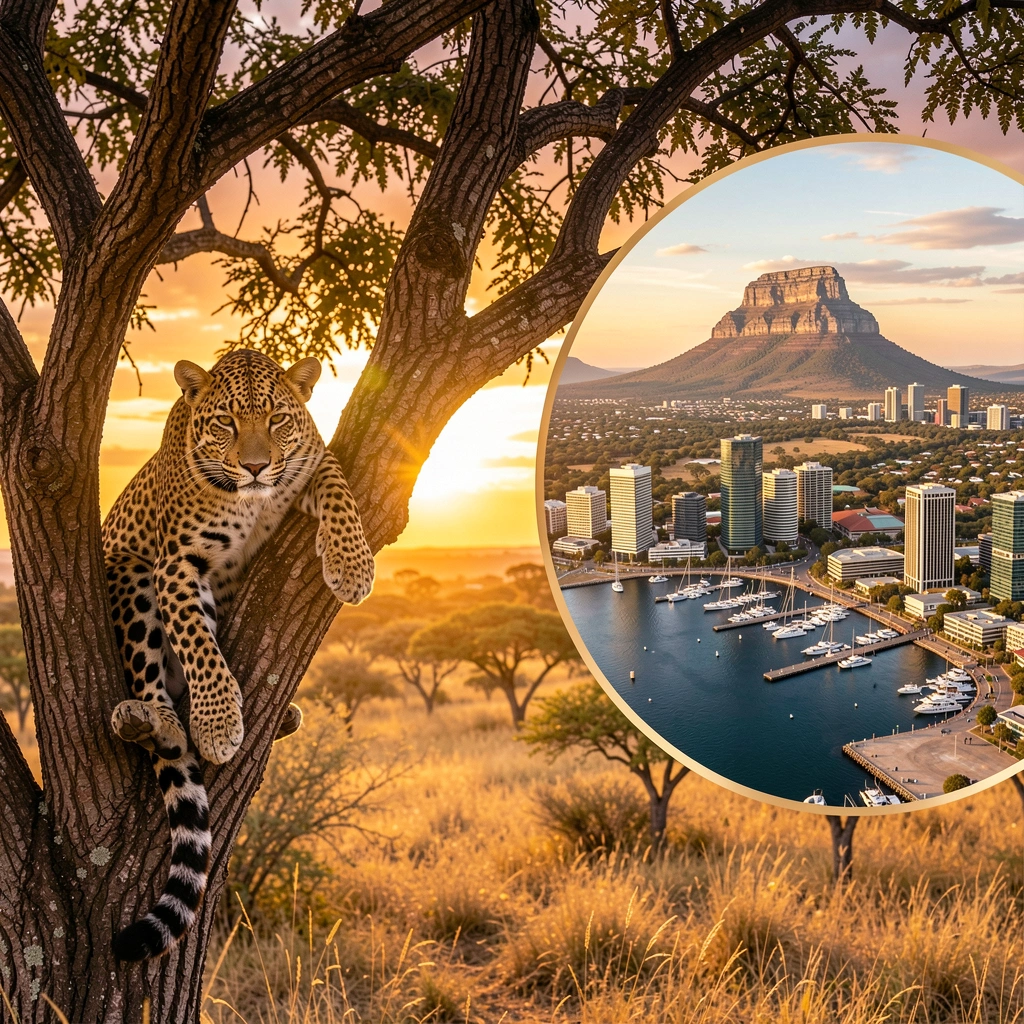
The safari half is based at Lion Sands River Lodge, on the banks of the Sabie River inside the Sabi Sand. It is a private reserve on Kruger’s western side, not part of the national park itself. For a wider look at the regions and lodge styles we sell, see our guide to luxury safari holidays.
Private reserve or Kruger National Park?
The two areas share an unfenced boundary, so the same elephant herds, lion prides and leopards move between them. The difference is how you see them. In the national park you drive public tarred and gravel roads, can self-drive and must stay on the road. In the Sabi Sand only lodge vehicles operate, and rangers can leave the track to follow a leopard into the bush or position the vehicle at a sighting.
That access comes with a trade. Park rest camps usually cost less and suit travellers happy to drive themselves. A private lodge suits a first safari, where the guiding does the work and you do not plan routes, gate times or meals.
What a game-drive day looks like
Mornings start before sunrise with a drive of several hours in an open vehicle. A ranger drives and interprets while a tracker reads spoor from a seat on the bonnet. Back at the lodge, the middle of the day is quiet time, when most animals rest in the shade. A guided bush walk on foot can replace some of this downtime. The afternoon drive leaves in the late afternoon and returns after dark, using a spotlight for nocturnal animals such as hyena and genet. On the arrival day the first drive starts soon after you reach the lodge, and on the last morning there is one more drive before the flight to Johannesburg.
How much does a Cape Town and Kruger safari holiday cost from the UK?
The table shows the from-price for each departure month from November 2026. October 2026 is the lowest month currently loaded, and dates are priced up to April 2027.
| Departure month | Economy pp | Business pp |
|---|---|---|
| November 2026 | £6,039 | £10,499 |
| December 2026 | £6,159 | £10,699 |
| January 2027 | £6,279 | £10,899 |
| February 2027 | £6,399 | £11,099 |
| March 2027 | £6,519 | £11,299 |
| April 2027 | £6,639 | £11,499 |
Prices are per person, based on two sharing. They also cover the hotels, transfers, the guided Cape days, the cableway and the lodge’s game drives and walks. Two things move the figure most: the month you travel and the cabin you fly. Occupancy and room type also change it, and a UK specialist confirms the exact price for your dates.
Usually extra, unless your quote says otherwise:
- tips for rangers, trackers, guides and lodge staff.
- drinks and spa treatments.
- travel insurance.
When is the best time for a Cape Town and Kruger safari?
The two halves peak at opposite ends of the year, so any date is a trade-off. Cape Town has winter rain, roughly May to August, and a dry, warm summer from about November to March. Kruger works the other way. Its dry winter, roughly May to September, thins the bush and draws animals to rivers and waterholes, which makes them easier to find. From about October to March, summer storms turn the bush green and many antelope drop their young.
September and October sit between the two. The Lowveld is still dry and open, and the Cape is warming up with fewer wet days.
Current departures run from October 2026 to April 2027. That puts your Cape days outside the winter rains, with long evenings for the Waterfront and the vineyards. In Kruger it means green-season game viewing. Thicker cover can hide animals, but the landscape is lush and birdlife is at its busiest with summer migrants. Newborn impala and wildebeest appear on the plains. Expect warm, humid days and afternoon thunderstorms at the lodge.
What to pack for a Cape Town to Kruger holiday
The two halves need different kit, so pack in layers rather than for one climate. Open vehicles are cold before sunrise even in summer, so bring a fleece, a warm hat and a light waterproof for storms. Neutral greens, browns and khaki suit the bush better than white or bright colours. Add binoculars, a sun hat, high-factor sunscreen and insect repellent for the lodge.
For the Cape, flat walking shoes with grip help on the Table Mountain paths and the rocks at Cape Point. A windproof layer is worth having for the cableway summit and Chapman’s Peak. Soft bags are easier to load on domestic flights and lodge vehicles than hard cases, and you should check your domestic baggage allowance before you pack.
Safety on a Cape Town and Kruger trip
The UK Foreign Office flags a few risks that apply directly to this route. Hikers in Table Mountain National Park have been attacked and mugged. The FCDO advises hiking in groups of four or more, avoiding quieter areas in the early morning and evening, and finishing before dark. The cableway avoids the issue.
At OR Tambo, criminals have followed travellers from the airport and robbed them. The FCDO advises arranging for your hotel or tour operator to meet you and using main roads. On this itinerary the airport hotel has direct access to the terminal, and transfers are arranged for you. If you add a township visit in Cape Town, go with a responsible, reliable guide rather than on your own. Scheduled power cuts, known as load-shedding, can still occur.
Extending a Cape Town and Kruger holiday
The simplest change is an extra night in Stellenbosch, turning the Winelands day trip into a stay. Other routes on our South Africa holidays page can replace or add to the Cape section. For a safari with a beach finish instead of a city, compare a Kenya safari and Zanzibar trip. More two-stop ideas are in our round-up of twin centre holidays.