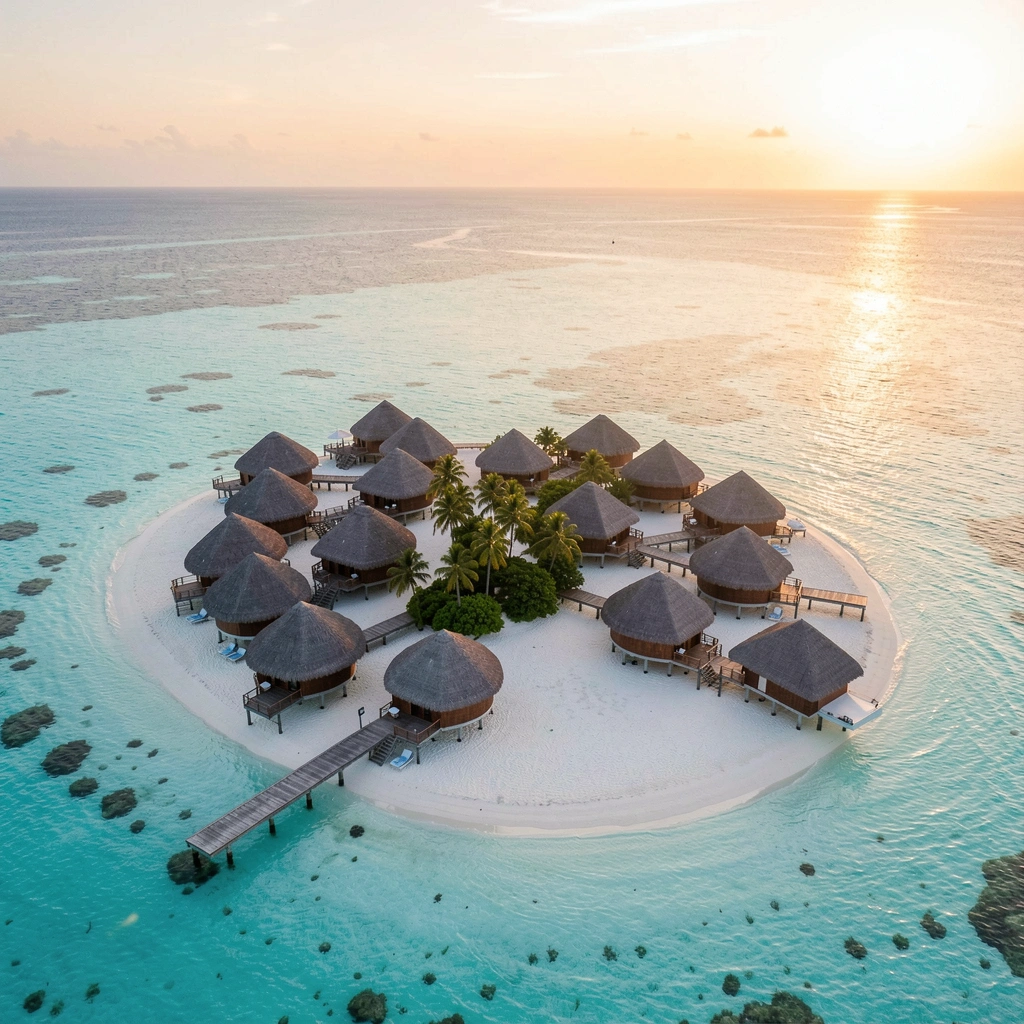
Close your eyes and picture this: you step off a seaplane onto a wooden jetty, the Indian Ocean stretching in every direction — impossibly blue, glassy calm, warm even at nine in the morning. A smiling member of staff hands you a chilled towel and a glass of fresh coconut water. Forty metres ahead, your overwater villa sits on stilts above a lagoon so clear you can count the fish from the deck. That is the Maldives. And it is every bit as extraordinary as the photographs suggest.
For UK travellers, the Maldives has long been the benchmark luxury holiday — the destination people save for years to experience, or book without hesitation for the most important occasions in their lives. At SuperDestinations, it is consistently our most requested long-haul destination, and we understand why. No other place on earth combines that particular quality of light, water, marine life, and total resort seclusion in quite the same way.
This guide covers everything you need to plan a luxury Maldives holiday from the UK in 2026 — the best atolls, how to choose between overwater villas and beach villas, honest pricing at every tier, the best time to travel, and what to expect when you get there.
What this guide covers:
— The different Maldivian atolls and which resorts suit which travellers
— Overwater villas vs beach villas — an honest comparison
— How much a luxury Maldives holiday actually costs from the UK
— Month-by-month weather and wildlife guide
— Getting there from the UK, including transfer options
— What’s included in a SuperDestinations Maldives package
— Frequently asked questions from UK travellers
Why The Maldives Is The Ultimate Luxury Destination
The Republic of the Maldives is an island nation in the Indian Ocean, made up of 1,192 coral islands grouped into 26 natural atolls. The vast majority of these islands are uninhabited. Sitting just four degrees north of the equator, the Maldives enjoys year-round warm temperatures, water between 28°C and 30°C in every season, and some of the richest marine biodiversity on the planet.
The overwater bungalow — now replicated in French Polynesia, the Caribbean, and elsewhere — was pioneered in the Maldives. The concept emerged here precisely because the geography demands it: the islands themselves are tiny, often barely 300 metres wide, so building out over the lagoon was the natural solution. The result is one of the world’s most distinctive accommodation experiences: a private villa suspended above turquoise water, with a glass floor section to watch the fish below, direct ladder access to the lagoon, and views that make it genuinely difficult to leave.
The marine life is exceptional even by tropical standards. Reef sharks patrol the shallows alongside eagle rays, sea turtles, and hundreds of species of reef fish. Whale sharks visit the Baa Atoll UNESCO Biosphere Reserve seasonally. Manta rays gather at cleaning stations. For divers and snorkellers, the Maldives frequently tops global rankings for visibility and diversity.
The resort island model — where each resort occupies its own private island, usually with no more than 50 to 150 villas — creates a level of seclusion that is genuinely difficult to achieve anywhere else. There are no day visitors, no public beaches shared with locals or other resorts, no taxis to nearby restaurants. The resort is your world, and at luxury level, that world is extraordinarily refined.
THE DIFFERENT ATOLLS EXPLAINED — WHERE SHOULD YOU STAY?
One of the first decisions to make when booking a Maldives holiday is which atoll to choose. The answer affects not just the resort options available but also the type and cost of your inter-island transfer.
North Malé Atoll is the most accessible. Velana International Airport sits on a small island adjacent to the capital, and North Malé Atoll resorts are typically reached by a 20 to 45 minute speedboat transfer costing £50 to £100 per person each way. This is the most practical option for travellers who want to minimise travel time on arrival. Several of the Maldives’ most celebrated resorts sit here, including One&Only Reethi Rah and Soneva Namoona. The tradeoff is that being closest to the capital means marginally more boat and seaplane traffic visible in the distance — though in practice it rarely intrudes.
South Malé Atoll requires a short speedboat transfer and offers a slightly quieter feel. Resorts here include Anantara Veli and Anantara Dhigu. The Adaaran Select Meedhupparu, one of our most popular packages starting from £2,029 per person, sits in Raa Atoll to the north, reached by a short domestic flight followed by a speedboat transfer — the combination is efficient and smooth.
Baa Atoll is the UNESCO Biosphere Reserve and the best atoll in the world for whale shark and manta ray encounters between May and November. Resorts in Baa Atoll — including the acclaimed Four Seasons Landaa Giraavaru and Amilla Maldives — require a 25 to 45 minute seaplane transfer from Male. That transfer costs between £150 and £350 per person each way and is itself a spectacle: the view from a seaplane over the atolls, the patterns of reef and sandbank visible through the shallow water below, is one of the great arrival experiences in travel.
Lhaviyani Atoll sits further north and is home to Kanuhura and Kuredu. It requires a domestic flight to Maafaru Airport followed by a short speedboat. This atoll suits travellers who want genuine distance from the capital without the seaplane cost.
Addu Atoll — the southernmost atoll, almost at the equator — is among the most remote and secluded. Resorts here are few but exceptional. Transfer requires a domestic flight of around 90 minutes. For travellers seeking absolute peace and a genuinely off-the-map feeling, Addu delivers.
OVERWATER VILLAS VS BEACH VILLAS — WHICH IS RIGHT FOR YOU?
The overwater villa is arguably the defining symbol of the Maldives, and for many travellers, booking one is the whole point. But it is worth being honest about both the appeal and the practicalities, because a premium beach villa at the right resort can offer an experience that is just as extraordinary — and sometimes better suited to the traveller.
The case for an overwater villa: the sense of being suspended above the ocean, with no land visible in any direction from your deck, is genuinely unlike anything else in travel. At sunrise, the water changes colour through a sequence of blues and greens that no photograph does justice. Having your own ladder down to the lagoon — stepping directly from your bedroom into 28°C crystal-clear water without sharing a beach with anyone — is a pleasure that does not diminish. The glass floor section in most overwater villas, through which you can watch reef fish, rays, and occasionally small sharks moving beneath you, is endlessly engaging.
The case for a beach villa: you have direct access to soft white sand from your room, without the ladder entry that overwater villas require (which can be challenging for older travellers or young children). Beach villas are almost universally larger in floor area for the same price point. The garden — typically lush, private, and fragrant — gives the villa a different kind of luxury. And a premium beach villa with private pool, at a good resort, can be the more serene choice for travellers who want to read and rest as much as swim.
Who suits overwater: honeymooners seeking a once-in-a-lifetime romantic experience; snorkellers and divers who want direct lagoon access; anyone for whom the bucket-list overwater experience is the primary motivation for visiting.
Who suits beach: families with young children (the sand is safer and more practical); older travellers for whom a ladder into the sea is not ideal; anyone who wants more space for the same budget; travellers who prioritise garden privacy over lagoon views.
The price differential is typically £300 to £600 per person for a seven-night package, overwater over beach. Whether that premium is worth it depends entirely on what you have come for.
How Much Does A Luxury Maldives Holiday Cost From The Uk?
The Maldives encompasses extraordinary breadth of pricing, from budget guesthouses on local islands to private island resorts at £15,000 per person for a week. Here is an honest breakdown of what each tier delivers, with prices based on a seven-night package including return flights from the UK. All prices are examples and vary by season and availability — call us for a current personalised quote.
Budget Maldives (£800 to £1,500 per person): This tier covers guesthouses on local inhabited Maldivian islands — places where Maldivian families live, where there is a community, a mosque, a school. The experience is genuinely interesting but entirely different from the resort island model. Bikini beaches are restricted to designated areas out of respect for the local Muslim community. Restaurants are local and simple. You access good snorkelling by boat. For travellers who want to understand Maldivian culture rather than float above it in a luxury bubble, local islands are fascinating and honest. But this is not what most UK travellers are looking for when they say Maldives.
Mid-Range (£1,500 to £2,500 per person): This is the sweet spot for most couples. A four-star resort island, half-board meal plan, beach bungalow or entry-level water villa, speedboat transfer. You are in the resort island world — private beach, house reef steps from your door, watersports, spa, multiple restaurants. The experience is genuinely special. Our Adaaran Select Meedhupparu package, for example, starts from £2,029 per person for seven nights including return flights, speedboat transfer, all meals, and snorkelling. This is excellent value for what is unambiguously a luxury experience.
Luxury (£2,500 to £4,500 per person): Full five-star resort, all-inclusive board including premium drinks, overwater villa option, seaplane transfer, private beach, twice-daily housekeeping, spa credit. At this tier, you are in the world of chandelier-lit overwater restaurants, private sunset cruises, reef conservation experiences, and menus that change nightly. The service-to-guest ratio climbs noticeably. This is where the Maldives fully delivers on its reputation.
Ultra-Luxury (£5,000 per person and above): Private island resorts, butler service, helicopter or private seaplane transfers, villa with private pool, bespoke daily programming. Resorts like Soneva Jani, Velaa Private Island, and One&Only Reethi Rah operate at this level. The staff-to-guest ratio can approach 1:1. Nothing is unavailable. This is among the finest hospitality anywhere in the world.
Beyond the base package price, budget for transfers if not included (seaplane £150 to £350 per person each way), daily excursions (whale shark snorkel £80 to £120 per person, sunset dolphin cruise £50 per person, sandbank picnic £100 per person), spa treatments (£100 to £400 per treatment at five-star resorts), and travel insurance — which is genuinely essential given that the resort medical clinic is basic and serious emergencies require seaplane evacuation.
Best Time To Visit The Maldives From The Uk
The Maldives has two seasons, driven by the monsoon system, and understanding them helps enormously with both experience and cost.
November to April is the dry northeast monsoon season — the Maldives at its most classic. Skies are blue, seas are calm, rainfall is minimal, and underwater visibility can reach 30 metres or more. This is peak season, when prices are at their highest. Christmas and New Year attract a premium of 30 to 40 per cent above standard peak pricing, and the best overwater villas at top resorts sell out as much as 18 months in advance. November is often the best value window within this period — the dry season is well underway but the Christmas premium has not yet arrived.
May to October is the southwest monsoon — what most guides call the wet season, though this is somewhat misleading. Rain in the Maldives tends to arrive in sharp afternoon showers rather than as sustained downpours. Mornings are frequently sunny, the water remains 28 to 30°C, and the reduced visitor numbers create a noticeably quieter resort atmosphere. Prices drop by 20 to 30 per cent compared to peak season. September is typically the cheapest month.
The wet season brings its own extraordinary wildlife calendar. Whale sharks arrive at Baa Atoll UNESCO Biosphere Reserve, typically from May through October, drawn by plankton blooms. Manta rays gather at cleaning stations from May to November. This is the best time for serious marine life encounters, and many divers actually prefer the wet season precisely for these reasons.
For most UK couples who are flexible on timing, we recommend either November (dry season beginning, excellent weather, below Christmas pricing) or May to early June (shoulder season, first whale sharks arriving, 20 to 25 per cent savings). Both offer an outstanding Maldives experience.
Getting To The Maldives From The Uk
There are no direct flights from the UK to the Maldives. All routes connect through a Gulf hub, which actually works very well given the geography.
British Airways operates a codeshare with Qatar Airways from London Heathrow via Doha — total journey time approximately 10.5 hours. Emirates flies from multiple UK airports including London Heathrow, London Gatwick, Manchester, Birmingham, and Glasgow, via Dubai. Qatar Airways flies from Heathrow and Manchester via Doha. Etihad connects via Abu Dhabi. All of these routing options work well, and for UK travellers outside London, the Emirates and Qatar routes via their hubs often offer convenient connections from regional airports.
Upon landing at Velana International Airport on the island of Hulhule, adjacent to the capital Male, you will need to transfer to your resort island. This is either by seaplane — a 15 to 45 minute flight over the atolls, costing £150 to £350 per person each way — or by speedboat, a 20 to 90 minute journey costing £50 to £150 per person each way depending on the resort’s distance from the airport. For many travellers, the seaplane transfer is itself a highlight of the trip.
No UK citizen needs to apply for a visa before travelling to the Maldives. A free 30-day visa on arrival is issued at Velana Airport. Your passport must be valid for at least six months beyond your return date.
What’s Included In A Superdestinations Maldives Package
When you book a Maldives holiday through SuperDestinations, your package includes return flights from a UK airport of your choice, private transfers to and from your resort island (seaplane or speedboat according to the resort), accommodation for the confirmed duration, your chosen meal basis (half board, full board, or all-inclusive depending on the package), and full ATOL financial protection under our licence number 10713.
You will receive your ATOL Certificate within 24 hours of booking — your guarantee that your money is fully protected should anything unexpected occur with the operator or airline.
Our consultants are available seven days a week from 9:30am to 10pm — reachable by phone on 0203 727 6363 or via WhatsApp — and they remain your point of contact from the moment you book until you return home. If a flight is disrupted, if something is not right at the resort, or if you have a question in the middle of your holiday, you call us directly.
Optional extras we can arrange include full board or all-inclusive upgrades, spa treatment packages, excursion programmes (whale shark snorkelling, private sandbank dinner, dolphin sunset cruise), and romantic additions such as flower arrangements, champagne, or a private beach dinner for special occasions.
Ready To Book Your Maldives Holiday?
Our Maldives specialists have helped thousands of UK travellers book the holiday of their lives. Whether you want a seven-night honeymoon in an overwater villa, a twin-centre combining Dubai with a Maldives resort stay, or a family beach holiday with young children, we will find the right fit at the right price — and protect every penny with our ATOL licence 10713.
Call us on 0203 727 6363, any day from 9:30am to 10pm. Or send us a WhatsApp message and one of our consultants will respond within two hours with personalised options. Your quote is always free, always tailored, and always backed by 4.9 stars from 3,200 verified Trustpilot reviews.