Where to go in Turkey depends on which coast you pick before which hotel. Istanbul straddles the Bosphorus, Izmir, Çeşme and Bodrum face the Aegean, Antalya looks south over the Mediterranean, and Marmaris sits on the corner where the two seas meet. This guide compares the five bases most UK travellers choose between, by airport, beach, sea temperature and season, then covers twin-centre routes and the rules to check before you fly.
Quick answer
Go to Istanbul for a city break of mosques, bazaars and Bosphorus ferries. For a beach week, couples suit Bodrum’s polished Aegean bays and Izmir and Çeşme mix city with coast. Families do best in Antalya’s Lara or Belek resorts, or in Marmaris and İçmeler for a sheltered bay and boat days.
Where to go in Turkey: the five main bases compared
Turkey’s holiday regions are far apart. Istanbul to Antalya is a domestic flight rather than a drive, and even neighbouring Aegean resorts sit hours apart by road. Treat each base as its own trip with its own airport.
| Base | Coast | Best for | Airport and transfer | Beaches | Main season | Feel |
|---|---|---|---|---|---|---|
| Istanbul | Bosphorus, split between Europe and Asia | Culture, food, short breaks | Istanbul Airport (IST) on the European side, or Sabiha Gökçen (SAW) 32 km south-east of the centre on the Asian side | Not a beach base: the water is for ferries and views | All year, most comfortable in spring and autumn | Huge, busy, late-night city |
| Bodrum | Southern Aegean | Couples, luxury, beach clubs | Milas-Bodrum (BJV), 36 km from Bodrum town, roughly 45 minutes | Coves and bays spread around a long peninsula | Late May to October | Stylish, spread-out, lively in town |
| Izmir and Çeşme | Northern Aegean | City plus beach, Ephesus, Turkish weekend scene | Izmir Adnan Menderes (ADB), 14 km from Izmir; Çeşme is 85 km west by the O-32 motorway | Peninsula beaches with a fresher sea | July to September for swimming | Local, relaxed, less packaged |
| Antalya | Mediterranean (Turkish Riviera) | Families, all-inclusive, golf | Antalya (AYT), 13 km north-east of the city; Lara is closest, Belek about 35 km | Long sandy strip at Lara, resort beaches at Belek | May to October, the longest swim season | Big resorts beside a walled old town |
| Marmaris | Where the Aegean meets the Mediterranean | Boat trips, families, nightlife in town | Dalaman (DLM), about 90 km and around 90 minutes; Bodrum is the alternative | Bay beaches backed by pine hills, with İçmeler next door | May to October | Harbour town, quieter bays nearby |
For a wider look at the country, the Turkey destination hub lists every region and holiday type in one place.
Where should you stay in Istanbul?
Stay in Sultanahmet to walk to the headline monuments, or in Beyoğlu for restaurants, bars and a livelier evening. Both are on the European side, separated by the Golden Horn inlet.
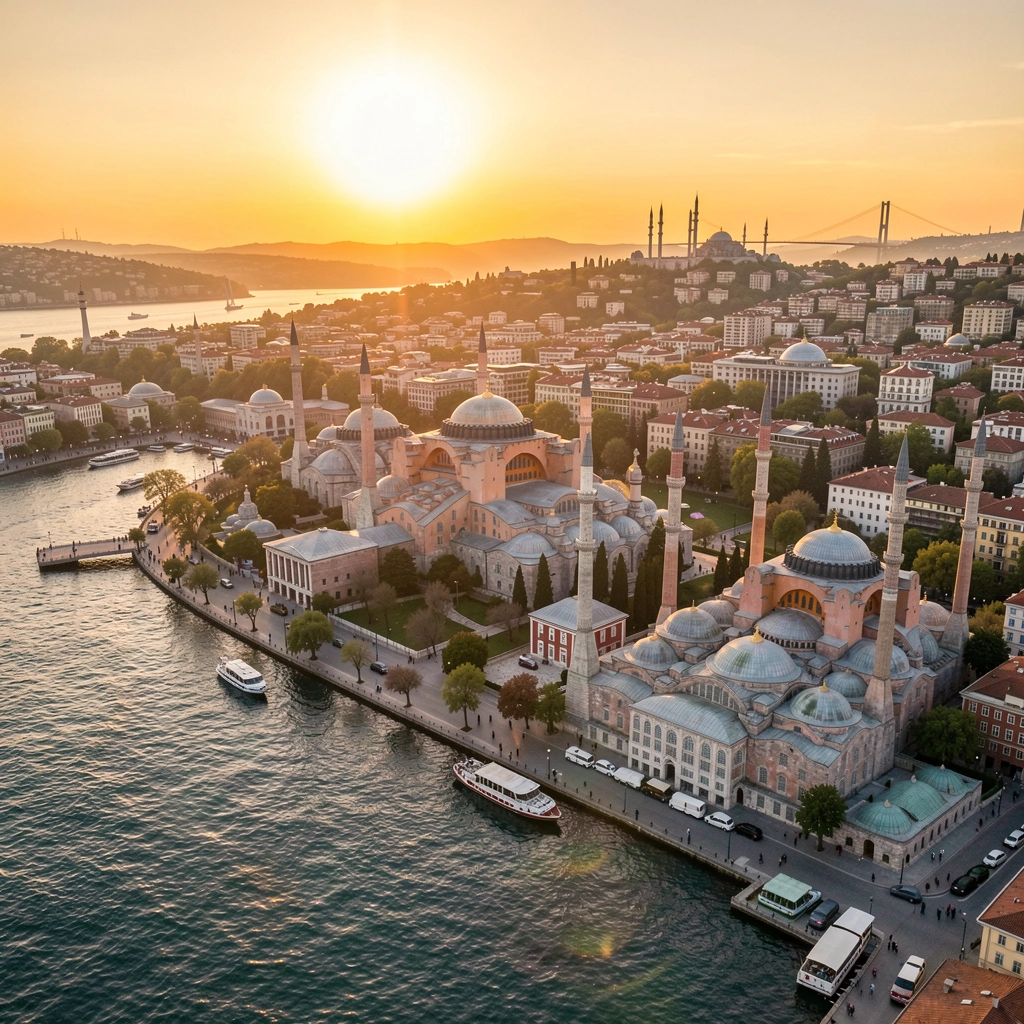
Sultanahmet sits on the old walled peninsula, the core of UNESCO’s Historic Areas of Istanbul listing, inscribed in 1985. Hagia Sophia, the Blue Mosque (Sultan Ahmed Mosque), Topkapı Palace and the Grand Bazaar are all within walking distance of one another, which is why first-time visitors base themselves here. The trade-off is that the streets empty out after dinner.
Beyoğlu, historically known as Pera, faces the old city across the Golden Horn. It covers Galata, İstiklal Avenue and Karaköy, and it is where most of the city’s rooftop bars and newer restaurants cluster. Kadıköy, on the Asian shore, is a short ferry ride away and worth an evening for its food market streets.
The official GoTürkiye Istanbul guide frames the city as a crossroads of Europe and Asia, and that is the practical point: a Bosphorus ferry is both sightseeing and public transport. Most people find three nights covers the historic peninsula and one Bosphorus trip, while four or five nights leaves room for the Asian side and a slower pace. Choose the neighbourhood first when comparing Istanbul city breaks, because it shapes every evening of the trip.
Is Bodrum the best choice for a luxury Turkish beach holiday?
Bodrum is the most polished of Turkey’s Aegean resorts, but its best hotels are scattered around the peninsula rather than in Bodrum town itself. Picking the right bay matters more than picking the resort.
- Bodrum town wraps around a harbour guarded by Bodrum Castle, built by the Knights Hospitaller in the 15th century, according to GoTürkiye’s Bodrum guide. It has the bars, the marina promenade and the busiest nightlife.
- Yalıkavak, on the north-west of the peninsula, grew up around its marina and is the smartest address for shopping and restaurants.
- Türkbükü (Göltürkbükü) on the north coast is the beach-club bay, where guests at most hotels swim from wooden jetties.
- Gümüşlük, a fishing port at the western tip, is the quietest of the four, with fish restaurants along the waterfront.
- Bitez and Turgutreis are more relaxed, with easier beach access and a wider mix of hotels.
Transfers to the outer bays take closer to an hour from the airport, so a late-evening flight can mean a midnight check-in. Bodrum holidays suit couples and adult groups best, and the peninsula’s hills mean few hotels have long flat beaches. Expect sun decks and jetties rather than acres of sand.
Bodrum or Antalya: which should you choose?
Choose Bodrum for smaller-scale hotels on an Aegean bay and a social, restaurant-led evening. Choose Antalya for bigger resorts, sandy beaches, a warmer sea and a shorter transfer.
The two coasts feel different. The Aegean is fresher and more wind-affected, with rocky coves and whitewashed towns. The Mediterranean around Antalya is hotter, the resorts are larger, and many of the hotels are designed so families never need to leave the grounds. Bodrum rewards people who like to eat out and move between bays. Antalya rewards people who want everything on site.
Why pick Izmir and Çeşme?
Izmir and Çeşme suit travellers who want a real Turkish city, a beach peninsula and the ruins of Ephesus in one trip, with less of the packaged feel of the southern resorts.
Izmir is the largest city on Turkey’s Aegean coast. Its seafront promenade, the Kordon, runs through the Alsancak district, and the Kemeraltı historical bazaar sits behind Konak Square and its clock tower, as the GoTürkiye Izmir guide describes. It works as a two-night stop rather than a beach base.
Çeşme, at the western tip of the peninsula, is a long-established Turkish summer resort rather than a purpose-built one. The area has a long thermal heritage, and neighbouring Alaçatı is known for its stone houses, vineyards, windmills and boutique hotels. The north wind that keeps summer evenings comfortable also keeps the sea cooler than on the south coast.
The big draw inland is Ephesus, inscribed by UNESCO in 2015. The ancient city lies beside Selçuk in Izmir province, with the Library of Celsus and a theatre built for around 24,000 spectators. Izmir holidays are the most straightforward way to see Ephesus without a long coach day from another resort.
Is Antalya best for all-inclusive family holidays?
Antalya is Turkey’s strongest region for all-inclusive family holidays, because it has the largest concentration of big resorts, the sandiest beaches and the warmest summer sea of the five bases.
Split the coast into three areas before you look at hotels:
- Lara, east of the city and the nearest resort area to the airport, has a long sandy beach lined with large all-inclusive hotels, several of them built as replicas of landmarks such as Topkapı Palace.
- Belek, further east, has more than thirty four- and five-star hotels, spa resorts and Turkey’s main cluster of golf courses. It is the quieter, more spread-out choice.
- Kaleiçi is Antalya’s walled old town above the old harbour, with Roman, Byzantine, Seljuk and Ottoman layers. It is a place for a boutique hotel and a few days of wandering, not a beach week.
Families usually pick Lara for the short transfer or Belek for space. Couples who dislike large resorts are often happier with two nights in Kaleiçi before or after a beach stay. Antalya all-inclusive holidays cover the resort side of that choice.
What is Marmaris like, and is İçmeler quieter?
Marmaris is a lively harbour town on a deep bay ringed by pine-covered hills, and İçmeler, 8 km to the south-west, is its calmer neighbour. İçmeler generally suits families, and Marmaris itself suits groups.
The GoTürkiye Marmaris guide describes the town as the point where the Mediterranean meets the Aegean, with its castle, port and marina together in the centre. It is one of Turkey’s main bases for traditional gulet cruises, so a day on a wooden boat around the bays is the classic excursion. The town’s bar street keeps the centre loud until late in summer.
İçmeler is surrounded on three sides by pine forest, with a seafront promenade and slower evenings. Dalaman airport also serves Fethiye, Ölüdeniz, Dalyan, Kaş and Kalkan, so a Marmaris stay can be paired with a few nights further along the coast. Marmaris holidays are the most sociable of the five options.
Istanbul or Bodrum: can you do both?
Yes. Istanbul and Bodrum answer different questions, and many of the best Turkey trips combine them. Istanbul gives you history, food and a big-city pace. Bodrum gives you a slower beach week afterwards.
Choosing just one comes down to the length of the trip. A short break favours the city, because a beach resort needs time to pay off. A week favours a coast, and a longer trip is best split between the two.
When is the best time to visit Turkey?
The best time to visit Turkey is May to June or September to October, when the coast is warm enough to swim and the cities are comfortable for walking. July and August bring the hottest weather and warmest sea, and winter suits Istanbul only.
The table gives average daytime highs and average sea temperatures by month. Air temperatures for Istanbul, Izmir and Antalya come from the Turkish State Meteorological Service (MGM) long-term averages, with Bodrum and Marmaris from Climates to Travel, which also supplies the sea readings.
| Month | Istanbul | Izmir | Bodrum | Marmaris | Antalya |
|---|---|---|---|---|---|
| January | 10°C / 8.5°C | 13°C / 15.5°C | 15°C / 17°C | 15°C / 17.5°C | 15°C / 17.5°C |
| February | 10°C / 7.5°C | 14°C / 15°C | 15°C / 16.5°C | 15°C / 16.5°C | 16°C / 16.5°C |
| March | 12°C / 8°C | 16°C / 15°C | 18°C / 16°C | 18°C / 16.5°C | 18°C / 17°C |
| April | 17°C / 10.5°C | 21°C / 16°C | 21°C / 17°C | 21°C / 17.5°C | 21°C / 18°C |
| May | 22°C / 15.5°C | 26°C / 18.5°C | 26°C / 19°C | 26°C / 20°C | 26°C / 20.5°C |
| June | 27°C / 20.5°C | 31°C / 22°C | 31°C / 22°C | 31°C / 23°C | 31°C / 24°C |
| July | 30°C / 23.5°C | 33°C / 23.5°C | 34°C / 23.5°C | 35°C / 25°C | 34°C / 27°C |
| August | 30°C / 24.5°C | 33°C / 24.5°C | 34°C / 24.5°C | 34°C / 26.5°C | 34°C / 28°C |
| September | 26°C / 22.5°C | 29°C / 23°C | 30°C / 23.5°C | 31°C / 25.5°C | 31°C / 27°C |
| October | 21°C / 19°C | 24°C / 21°C | 26°C / 21.5°C | 26°C / 23.5°C | 27°C / 24.5°C |
| November | 16°C / 14.5°C | 19°C / 18.5°C | 20°C / 19.5°C | 20°C / 20.5°C | 21°C / 21°C |
| December | 12°C / 11°C | 14°C / 16.5°C | 17°C / 17.5°C | 16°C / 18.5°C | 17°C / 18.5°C |
Three patterns stand out. First, Istanbul’s sea stays far colder than the south coast for most of the year, which is another reason to treat it as a city break. Second, Antalya’s sea is still around 27°C in September, making it the safest bet for an autumn half-term swim. Third, winter on the coast is wet as well as cool: Antalya averages about 251 mm of rain in December and under 5 mm in July, according to MGM.
The FCDO warns of a high wildfire risk on the coast from April to October. Check local news when you arrive and follow instructions from hotel staff and emergency services.
Which Turkish resort suits you?
Once you have picked a coast, these tie-breakers usually settle the resort itself:
- Only four or five nights on the beach: keep the transfer short. Lara, Bodrum town or Bitez waste less of the first and last day than Belek, Yalıkavak, Gümüşlük or anywhere reached from Dalaman.
- A late-evening arrival: the same logic applies, because an hour-long transfer after the flight means a very late check-in.
- Quiet evenings: stay outside the party centres. Gümüşlük, İçmeler and Belek are calm after dark, while Bodrum town and central Marmaris stay loud in July and August.
- No hire car: Istanbul, Kaleiçi and Marmaris town are walkable, whereas the Bodrum peninsula spreads across separate bays that you reach by taxi or local minibus.
- Ancient sites without a long coach day: base yourself in Izmir or Kaleiçi rather than a resort an hour or more from the ruins.
How do you combine Istanbul with the coast or Cappadocia?
Fly. Domestic flights link Istanbul’s two airports with Bodrum, Izmir, Dalaman and Antalya, which turns a city-and-beach trip into one flight rather than a long drive. These are the combinations that work best:
- Istanbul and Bodrum: a city stay first, then a week on the Aegean. The natural choice for couples.
- Istanbul and Antalya: the family version, with a warmer sea and bigger resorts for the second half.
- Istanbul and Cappadocia: fly to Nevşehir Kapadokya (NAV) or Kayseri for two or three nights around Göreme. Its fairy chimneys and rock-cut churches form the Göreme National Park and the Rock Sites of Cappadocia World Heritage Site, inscribed in 1985.
- Izmir, Ephesus and Pamukkale: an inland loop to the white travertine terraces of Hierapolis-Pamukkale (UNESCO, 1988), about 20 km from Denizli, before returning to the coast.
Our guide to the best twin-centre holidays from the UK explains how to split nights between two stops, and the multi-centre holidays guide covers three-stop routes. For single-resort and twin-centre options side by side, start with our Turkey holidays.
What do UK travellers need to know before going to Turkey?
Check your passport dates first, then money, time and local customs. These points come up on almost every Turkey trip.
- Passport validity: the FCDO entry requirements for Turkey say a British passport must expire at least 150 days after the date you arrive and have at least one blank page.
- Flight time: direct flights from London take around four hours to Istanbul, Bodrum, Izmir and Dalaman, and a little longer to Antalya.
- Time zone: Turkey stays on UTC+3 all year, so it is two hours ahead of the UK in summer and three hours ahead in winter.
- Currency: the Turkish lira. You must not take lira worth more than US$5,000 out of the country, and larger sums in other currencies must be declared.
- Tipping: around 10% in restaurants is normal unless a service charge already appears on the bill. Leave it in cash.
- Mosques: dress modestly, cover shoulders and knees, remove your shoes, and women should cover their hair. Larger mosques lend scarves at the door, and visits pause at prayer times.
- Accommodation tax: Turkey charges a tax on hotel stays, temporarily cut from 2% to 1% for 2026 under Presidential Decision 11263; check the rate for your dates.
- Istanbul transport: the Istanbulkart is a contactless card for the metro, trams, buses and ferries. The tourist version can be shared by up to five people, and the M11 metro and Havaist coaches both run from Istanbul Airport into the city.
- Taxis and photos: the FCDO’s safety and security advice recommends registered, metered taxis or app-based services, and warns against photographing military or official sites.